By combining a natural polymer with therapeutic ions, porous silica carriers, and magnetic nanoparticles, researchers outline how one adaptable dressing could target several biological problems that make diabetic wounds so difficult to heal.
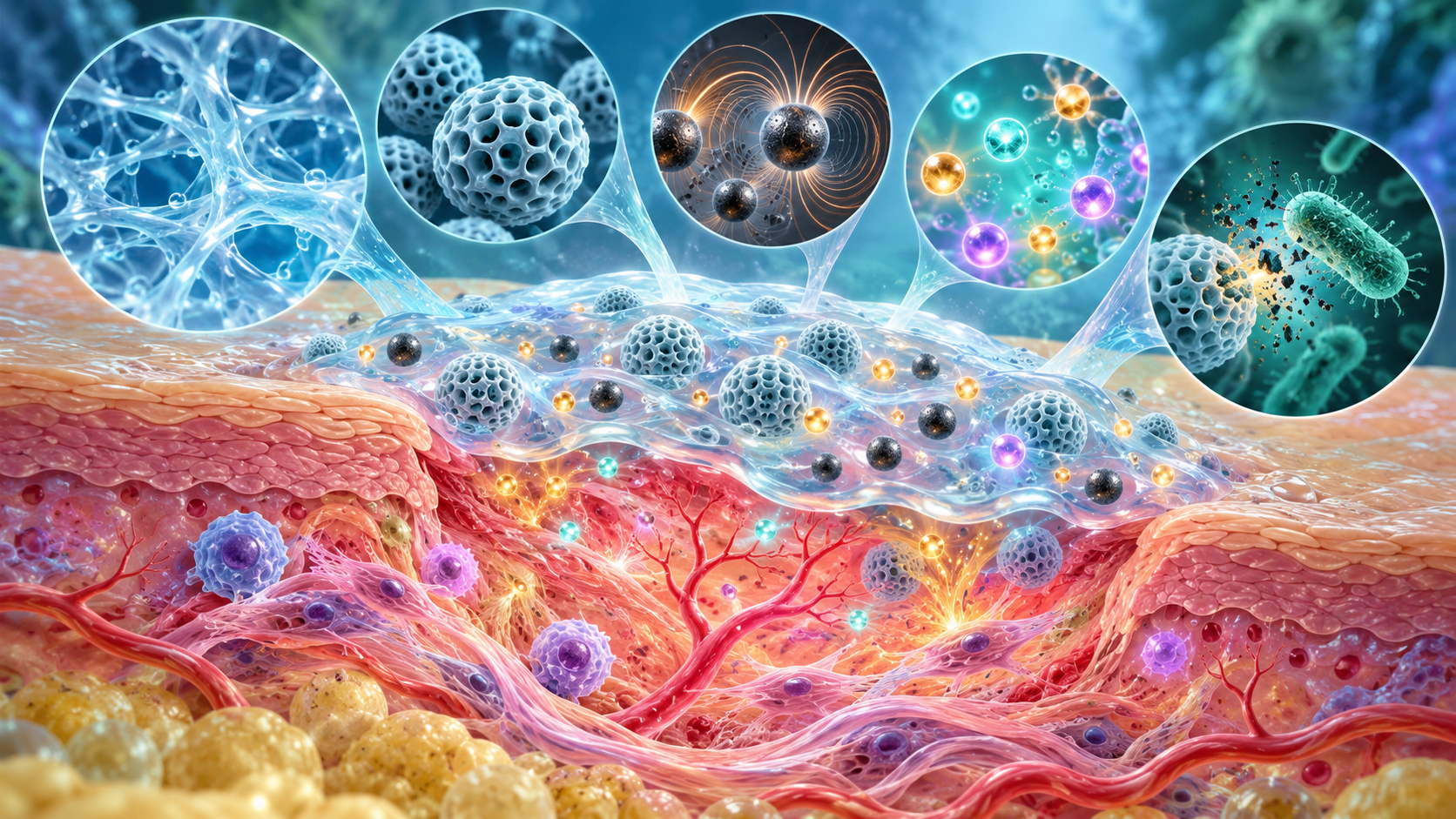
Paper: Potential of Chitosan-Based Systems Integrating Therapeutic Ions, Mesoporous Silica and SPIONs as Next-Generation Multifunctional Platforms for Diabetic Wound Healing. AI-generated abstract conceptual image created using ChatGPT/OpenAI
Diabetes disrupts several steps of the wound-healing process, leading to infection-prone chronic wounds that present a significant clinical burden. Chitosan (CS) is a cationic polysaccharide with a chemically tunable structure, high biocompatibility, antimicrobial activity, and hemostatic activity. This naturally occurring polysaccharide is an attractive platform for advanced wound dressings.
A recent review in Marine Drugs explored the potential of CS-based systems that integrate superparamagnetic iron oxide nanoparticles (SPIONs), mesoporous silica, and therapeutic ions for diabetic wound healing.
Multifunctional theranostic CS-based dressings
A single-component dressing is unlikely to address the complex needs of diabetic wounds. The authors propose combining chitosan, mesoporous silica nanoparticles (MSNs), therapeutic ions, and SPIONs into one engineered system, but they also note that no study has yet reported all four components together for chronic or diabetic wound healing.
Related studies cited in the review, including work in bone tissue engineering rather than diabetic wound models, used the marine-derived polysaccharides kappa-carrageenan (κ-C) and CS as natural, renewable biomaterial sources to fabricate different multifunctional architectures, including three-dimensional (3D) hybrid sponges and nanofibers. The review uses these studies as evidence that the proposed material architecture is feasible.
The sponges incorporated either engineered Santa Barbara Amorphous-15@iron (II, III) oxide (SBA-15@Fe3O4) composites, in which SPIONs were covalently attached to SBA-15, or SBA-15 nanoparticles. Some formulations also contained nanohydroxyapatite (n-HAp).
Capabilities demonstrated in related multifunctional materials
Engineered SBA-15@Fe3O4 composites increased the magnetic responsiveness of biopolymer sponges, enabling remote manipulation under external magnetic fields. During magnetic stimulation, these magnetic nanocomposites generated localized heating, with reported specific absorption rates up to 22.44 W/g, while limiting thermal damage to nearby tissues.
Based on application requirements, the thermal response can be tuned from mild hyperthermia to targeted cell ablation. Combining imaging capabilities with magnetic hyperthermia in one system demonstrates the theranostic potential of these multifunctional platforms.
SPION interactions with therapeutic ions
Under magnetic hyperthermia conditions, SPIONs could modulate ion diffusion through the CS matrix via magnetic-field control. Localized heating generated by adjusting magnetic field frequency and strength could increase ion diffusion and mobility.
The extent of this effect depends on the coating and composition of the magnetic nanoparticles and on the application, such as tissue engineering, wound healing, or antibacterial activity. The authors also note that no significant effect on ion diffusion has been observed under conventional tissue-engineering conditions, and any effect during magnetic hyperthermia remains unconfirmed and needs further study.
For in vivo magnetic hyperthermia, researchers often prefer iron oxide-based nanoparticles because of their strong magnetic response, low toxicity, and biocompatibility.
MSN interactions with therapeutic ions
MSNs can carry a wide range of therapeutic agents. Interactions between mesoporous silica surfaces and therapeutic ions could support ion loading and retention in the mesoporous system.
Surface silanol groups can reversibly bind therapeutic ions and may influence release kinetics and ion retention. The authors suggest that this could support sustained release and improve the biological performance of ion-containing systems in the diabetic wound microenvironment.
Part of this discussion is based on the authors' unpublished multi-ion SBA-15 data, which were under review and came from bone and dental tissue-engineering work.
The review cites a study by Vitázková et al. that found cobalt- and boron-co-doped mesoporous bioactive glass (MBG) nanoparticles showed the highest therapeutic ion release and degradation rates because of their larger specific surface area. This larger area promoted ion-exchange processes and solid-liquid interfacial interactions.
The corresponding particles coated with silicon dioxide showed more controlled release, prolonging therapeutic ion delivery while retaining comparable silicon release.
The findings suggest that a silica shell containing silanol groups can act as a selective barrier that regulates diffusion and modulates ion release and transport kinetics. The cited study linked this behavior to better biological outcomes.
Influence of diabetic wound pH
Diabetic wounds often have a mildly acidic microenvironment (pH 5.5-6.5) due to inflammation, limited oxygen supply, and bacterial infection, factors that contribute to delayed healing. pH-responsive CS dressings can respond to this environment by releasing therapeutic agents, including pro-regenerative molecules and antimicrobial compounds, on demand.
MSNs typically release cargo faster under acidic conditions because electrostatic interactions change and silica network hydrolysis accelerates. This response matters for their use in drug delivery.
Such pH-responsive systems could improve wound-healing outcomes by locally releasing therapeutic agents in response to pH, increasing treatment efficiency while limiting side effects and systemic exposure.
Surface silanol groups on MSNs could reversibly coordinate divalent cations, supporting sustained therapeutic delivery while modulating release kinetics through adsorption-desorption equilibria.
This effect may be stronger within this pH range, where therapeutic ions can be released more readily from ion-containing phases. SPIONs, especially when protected by inorganic or polymeric surface coatings, typically remain stable in the mildly acidic environment found in many diabetic wounds.
Under more strongly acidic conditions, the iron oxide core dissolves significantly, releasing Fe2+/Fe3+ ions. At the pH range characteristic of diabetic wounds, SPIONs are generally expected to retain their structural integrity and magnetic properties while remaining biologically functional.
The review proposes that the CS-based four-component design could help address the complex biological barriers that hinder diabetic wound healing. No dressing combining all four components has yet been reported for diabetic wounds, and preclinical and clinical studies are still needed to establish its safety, efficacy, and clinical potential.
Disclaimer: The views expressed here are those of the author expressed in their private capacity and do not necessarily represent the views of AZoM.com Limited T/A AZoNetwork the owner and operator of this website. This disclaimer forms part of the Terms and conditions of use of this website.