A reinforced microscopic edge helps fragile nano-thick electronics survive handling and repeated use while preserving the ultrathin skin contact needed for high-performance physiological, temperature, and pressure sensing.
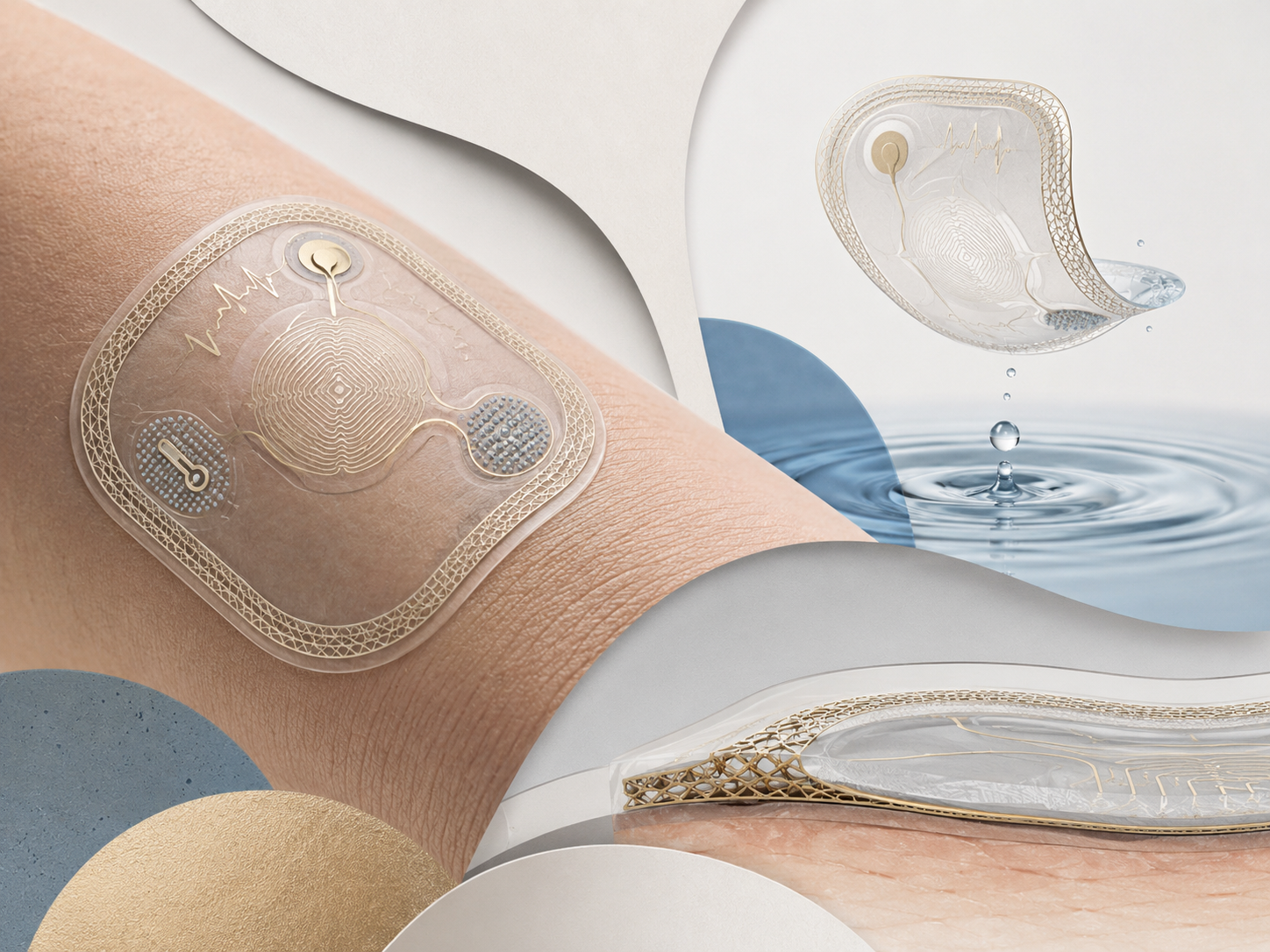
Paper: Nano-thick freestanding and reusable epidermal electronics via edge-supporting strategy. AI-generated conceptual image created using ChatGPT/OpenAI
A paper recently published in the journal Microsystems & Nanoengineering demonstrated an edge-supporting strategy, an innovative fabrication and design approach, to develop nano-thick epidermal electronics (NEE).
Issues due to Thickness Reduction
The exceptional conformability and lightweight characteristics of NEE enable an unnoticeable wearing experience and acquisition of high-quality signals. To achieve a comfortable wearing experience and excellent sensing performance, researchers have sought to reduce the thickness of epidermal electronics from several microns to the nanoscale.
However, a reduction in thickness affects the structural strength and bending stiffness of NEE. Thus, the devices wrinkle easily with slight disturbances, and flattening them becomes difficult once folded. Such issues create significant difficulties when manipulating NEE with tools like tweezers or by hand.
Device Preparation Challenges
The fabrication of NEE is another key challenge. Minimizing peeling stress while NEEs are released from their mother substrates is crucial for obtaining intact, high-quality films.
A sacrificial layer is commonly introduced for this process. The devices are released without interface competitive fracture due to peeling when an etchant is used to dissolve the sacrificial layer.
However, residual sacrificial material may remain on the donor substrate or the transferred functional layer, affecting the reuse and recovery of donor substrates and the performance of thin films.
Additionally, process compatibility challenges can arise due to the sacrificial layer. Thus, many other approaches, such as controlled spalling, laser-assisted peeling, and thermal-assisted release, have been developed to separate NEE from the mother substrate.
Yet, these approaches cannot fully prevent interface competitive fracture. Similarly, transfer printing techniques do not generally enable damage-free recycling of ultrathin devices, which is critical for long-term performance evaluation and reuse.
The Edge-supporting Strategy
In this work, researchers proposed a novel edge-supporting approach to address the conflict between the practicality and high performance of NEE. This strategy preserves the advantages of nano-thickness while achieving reusability and practicality through a reinforced edge scaffold.
In this strategy, the internal sensing area of the device is approximately 500 nm thick, while the peripheral edge of the device is reinforced to approximately 5 μm thick as a supporting scaffold.
Highly conformal and firm contact with the skin is enabled by the core area, while the edge scaffold provides rigid support during recycling and handling and protects the internal fragile film. In tests on a skin replica, the effective contact line across the sensing area exceeded 85%, although regions close to the thickened edge showed incomplete contact.
The Research Effort
Researchers fabricated an edge-supported nano-thick film with a serpentine island-bridge structure. Initially, a polyimide (PI) precursor solution was diluted in N-methyl-2-pyrrolidone (NMP) at a 1:2 volume ratio. For 30 min, the resultant mixture was stirred, then placed under vacuum for 30 min to eliminate bubbles.
Subsequently, researchers spin-coated the diluted PI precursor solution onto a 50 mm × 50 mm glass sheet and then step-cured it from 60 °C to 220 °C. The resulting approximately 0.5 μm PI film was then laser-cut to define the release edge.
A photosensitive PI layer was subsequently spin-coated and patterned to form the approximately 5 μm reinforced edge scaffold, before the functional materials were added to produce the electronic devices. The same step-curing procedure that was used for the ultrathin PI film was applied to cure the patterned PI photoresist layer.
Edge-supported nano-thick pressure sensor, surface electromyography (sEMG) electrode, and temperature sensor were also fabricated and characterized. A fingertip/skin replica was fabricated for this study.
How Effective is the Edge-supporting Strategy
Researchers successfully demonstrated the edge-supporting strategy for developing NEE. The nano-thick core provided excellent sensing performance and enabled conformal contact with human skin, while the edge scaffold provided rigid support during handling and protected the fragile internal film from tearing during peeling.
The edge scaffold was released from the rigid substrate by immersing it in deionized water, with most of the thickened edge separating within 10 to 30 min, depending on device size and design. The supporting edge could then be gripped with tweezers to complete removal. This release process avoided the need for a sacrificial release layer, chemical etchants, or transfer stamps to detach the ESU device from its mother substrate. It also enabled repeated detachment and reattachment of the NEE to target surfaces for repeated use.
Repeated use required surface cleaning because dead skin cells and sebum could accumulate on the ultrathin electrode. The researchers rinsed the electrode with ethanol and cleaned the target skin area between attachments to limit contamination and maintain adhesion and electrical performance.
To validate the feasibility of this strategy for practical use, researchers developed physiological electrodes with a contact impedance of about 3.6 kΩ at 1 kHz, compared with approximately 2.15 MΩ for commercial Ag/AgCl electrodes. By comparison, otherwise similar dry electrodes with a 5 μm sensing area had an impedance of approximately 198.27 MΩ, highlighting the performance advantage associated with the submicron sensing region. After more than 100 repeated detachments and signal acquisitions over one week, impedance increased to approximately 7.9 kΩ for the edge-supported electrodes, compared with 14.35 MΩ for the commercial electrodes.
The edge-supported electrodes also recorded forearm muscle activity during gripping tasks. Their signal amplitude increased with grip strength, while the measured signal-to-noise ratio reached 19.92 dB compared with 15.46 dB for the commercial wet electrodes.
An ultrathin resistance temperature detector was also developed with a response time of 0.48 ms, and a pressure sensor with a sensitivity of 62.9 kPa-¹ in its most sensitive pressure range. Both devices had sensitive areas less than 1 μm thick.
The researchers also noted a limitation of the PI platform: its poor air and water permeability caused skin redness and slight discomfort after prolonged attachment, providing an additional rationale for designing the electrodes to be removable.
In conclusion, the findings of this study demonstrated the viability of the proposed edge-supporting strategy as a reliable and effective solution for reusing, handling, and fabricating NEE, highlighting its potential to advance the practical use of these devices.
Disclaimer: The views expressed here are those of the author expressed in their private capacity and do not necessarily represent the views of AZoM.com Limited T/A AZoNetwork the owner and operator of this website. This disclaimer forms part of the Terms and conditions of use of this website.