By aligning single-handed carbon nanotubes into chip-scale films, scientists revealed a powerful nonlinear optical response that could help advance compact light-conversion technologies for silicon photonics, telecom systems, and quantum optical devices.
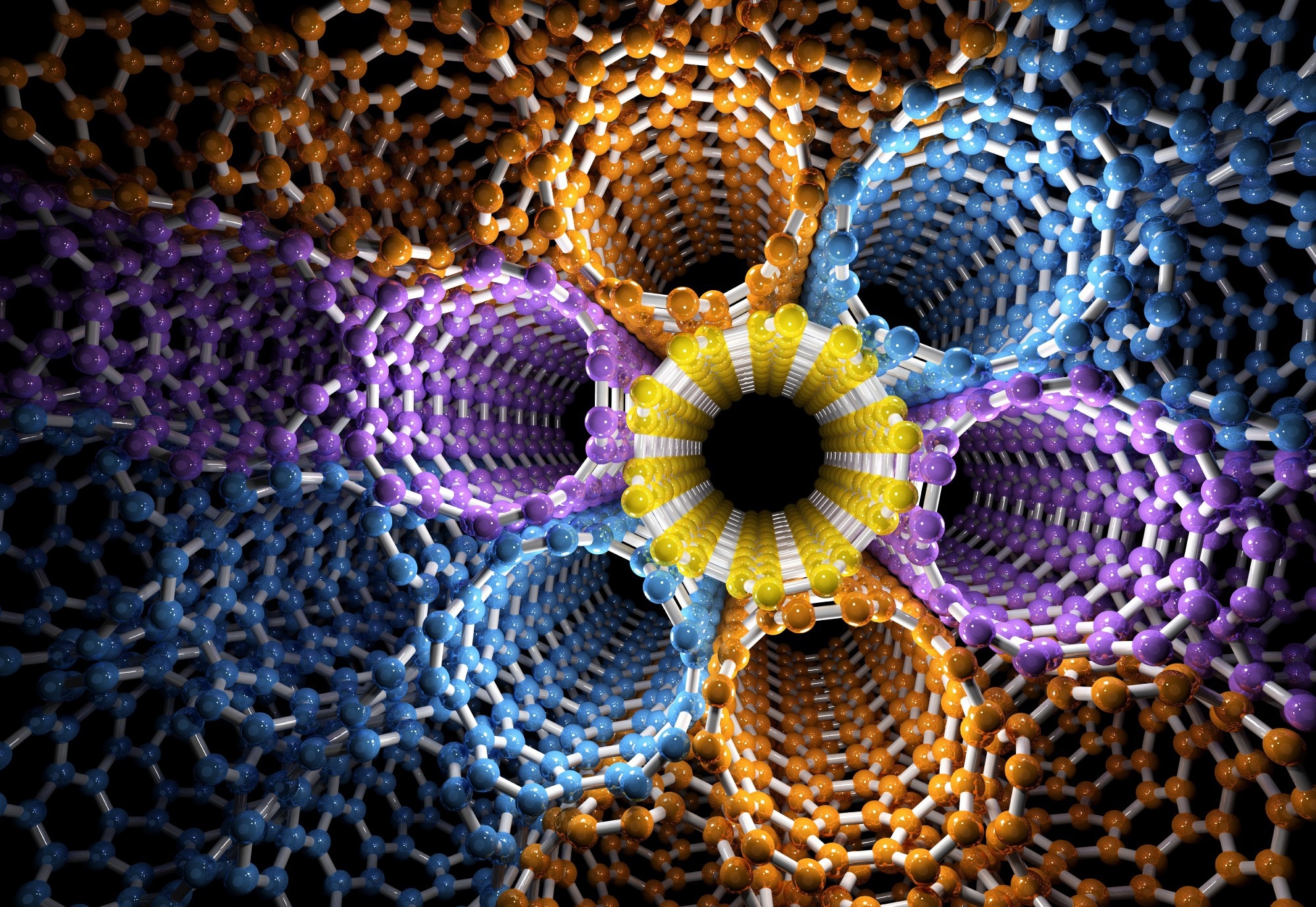
Research: Chip-Scale Aligned Chiral Carbon Nanotubes Exhibiting Giant Second Harmonic Generation. Image Credit: Forance / Shutterstock
A recent study published in the journal ACS Nano has introduced centimeter-scale films composed of highly aligned single enantiomer chiral carbon nanotubes. By assembling aligned, single-enantiomer films that preserve intrinsic chirality and avoid enantiomeric cancellation, researchers achieved a strong second-harmonic generation (SHG) effect.
They measured an effective film susceptibility of 4.9 × 10² pm/V, corresponding to an intrinsic crystal susceptibility of 1.6 × 10³ pm/V after correction for structural nonidealities, establishing a new benchmark for low-dimensional photonic materials and connecting molecular chirality to optical functionality.
Structural Chirality in Optical Nonlinearity
Structural chirality is a fundamental property in which a material cannot be superimposed onto its mirror image. In optical systems, this asymmetry can give rise to second-order optical nonlinearities, which are crucial for advanced light control across various applications. However, generating strong SHG signals from elemental materials has remained difficult because isotropic structures often cause optical signal cancellation at the macroscopic scale.
Chiral carbon nanotubes are promising candidates for overcoming these limitations due to their one-dimensional (1D) quantum-confinement properties. These nanostructures behave as direct-gap semiconductors dominated by 1D excitons with strong oscillator strengths. Although theoretical studies have predicted enhanced nonlinear optical behavior in these systems, experimental confirmation has been limited by difficulties in producing highly ordered arrays of pure single-enantiomer nanotubes.
Synthesis and Purification Techniques
To create a macroscopically ordered structure, researchers developed a multi-step synthesis and assembly process. This began with an aqueous suspension of single-walled carbon nanotubes undergoing automated gel chromatography using surfactant mixtures. By adjusting concentrations within Sephacryl gel columns, the study successfully isolated left-handed semiconducting carbon nanotubes, achieving an enantiomeric purity of 91.6%.
After purification, the nanotubes were assembled into macroscopic films using controlled vacuum filtration. The original surfactant system was replaced with sodium deoxycholate, followed by a three-stage filtration involving gravitational flow, pumping, and drying to regulate nanotube alignment. The resulting films, about 20 nm thick, were transferred onto fused silica substrates by dissolving supporting polycarbonate membranes in chloroform.
High-resolution scanning electron microscopy (SEM) confirmed dense film morphology and packing, while atomic force microscopy (AFM) measured film thickness across films with diameters of about 3 cm. Polarized Raman spectroscopy and polarized attenuance measurements were used to determine nanotube orientation and calculate the three-dimensional (3D) nematic order parameter.
Optical Performance and Metrics
The experimental analysis demonstrated exceptionally strong SHG emission from the aligned chiral carbon nanotube films. When excited near the lowest-energy E11 excitonic transition at 1030 nm, researchers observed a significant SHG signal that was detected only when the sample was tilted away from normal incidence. This confirmed that the optical response originated from the nanotube's intrinsic chirality and broken inversion symmetry.
The fabricated films reached a maximum effective second-order nonlinear susceptibility of 4.9 x 10² pm/V. After correcting for structural nonidealities, the intrinsic crystal susceptibility was calculated to be around 1.6 x 10³ pm/V at the 1.21 eV resonance peak, thereby marking it as the highest experimentally verified value for a 1D material system, to the best of the authors’ knowledge.
Power-dependent measurements showed that the SHG signal scaled quadratically at low excitation levels, with a power-law exponent of 2.04 ± 0.06. When the excitation fluence exceeded approximately 0.2 mJ/cm², the response deviated from quadratic behavior due to exciton annihilation-induced absorption saturation. Bethe-Salpeter equation-based many-body calculations indicated that strong excitonic effects were responsible for the enhanced nonlinear optical response.
Future Prospects in Photonic Applications
The development of scalable, high-performance chiral thin films opens new possibilities for optoelectronic and telecommunication technologies. These carbon nanotube films exhibit strong nonlinear optical responses at near-infrared wavelengths, making them promising candidates for integration into silicon photonics platforms and telecommunication chips. They may support efficient subwavelength optical frequency conversion and localized light modulation.
The films also show potential for applications in chiral quantum optics and integrated nanophotonic circuits. Their ability to be transferred onto different substrates enables the fabrication of dielectric resonators and optical metasurfaces. Researchers suggest that these properties could support advanced designs, such as periodic stacks using quasi-phase matching to enhance light harvesting and optical conversion efficiency.
Conclusion: Advancing Quantum Photonics
In summary, this study represents a significant advancement in nanotechnology by demonstrating strong second-order optical nonlinearities in chip-scale films composed of highly aligned, enantiomer-pure chiral carbon nanotubes. By isolating left-handed nanotube configurations and maintaining large-scale structural alignment, scientists enhanced the material's nonlinear optical response. The findings confirm theoretical predictions regarding many-body interactions in one-dimensional nanomaterials.
The scalable vacuum filtration method may provide a practical route for future large-scale fabrication. Future work could extend this approach toward wafer-scale, CMOS-compatible films with controlled nanotube diameters. Overall, combining these single-chirality structures with electrical gating and dielectric tunability could enable tunable optical devices across the ultraviolet to near-infrared wavelengths, thereby supporting the development of next-generation quantum photonic technologies.
Download your PDF copy by clicking here.
Disclaimer: The views expressed here are those of the author expressed in their private capacity and do not necessarily represent the views of AZoM.com Limited T/A AZoNetwork the owner and operator of this website. This disclaimer forms part of the Terms and conditions of use of this website.