By pairing monolayer graphene with conventional ITO, researchers improved nanoscale charge transport in transparent electrodes, opening a potential pathway toward lighter, more efficient solar power systems for future aerospace missions.
Research: 2D Nanomaterial-Based Transparent Electrodes for Next-Generation III–V Multijunction Space Solar Cells. Image Credit: annfossa / Shutterstock
A new study in the journal Engineering Proceedings investigates graphene–ITO hybrid transparent electrodes for next-generation space solar cells. The researchers demonstrate that integrating monolayer graphene with conventional indium tin oxide significantly improves nanoscale current response as measured by tunneling current while supporting transparent-electrode applications and preserving nanoscale surface uniformity across scanned regions.
The findings establish a promising approach to developing high-performance transparent electrodes that could support future, durable, and efficient solar power systems in demanding aerospace environments. The paper itself emphasizes nanoscale charge-transport characterization and notes that macroscopic measurements remain essential for device-level assessment.
Hybrid Nanomaterials Address Limitations of Conventional Electrodes
Space photovoltaic systems operate in extreme environmental conditions and require highly efficient and durable solar cells. Triple-junction GaInP/GaAs/Ge solar cells currently dominate space applications as they absorb multiple regions of the solar spectrum and achieve efficiencies of about 30% under AM0 conditions. However, transparent front electrodes continue to limit overall device performance due to electrical losses, reduced conductivity, and the mechanical brittleness of conventional indium tin oxide (ITO) films.
The researchers address these limitations by developing graphene–ITO hybrid transparent electrodes for next-generation space solar cells. Graphene offers exceptional carrier mobility, mechanical strength, and optical transparency, making it a promising material for advanced photovoltaic systems.
The study shows that graphene–ITO hybrid electrodes significantly improve local conductive pathways and increase nanoscale tunneling current by nearly 60% at the nanoscale. This work provides new insight into charge transport in graphene-enhanced transparent electrodes for lightweight, high-performance space photovoltaic systems, although full solar-cell performance was not tested in this study.
Fabrication and Multiscale Characterization of Graphene/ITO Electrodes
The researchers fabricated hybrid transparent electrodes by transferring monolayer graphene onto commercially available 100 nm thick ITO-coated glass substrates. They synthesized graphene using cold-wall chemical vapor deposition (CVD) and transferred the graphene layer onto pre-patterned ITO surfaces using a thermal release tape technique.
Researchers used Raman spectroscopy with a 532 nm excitation laser to determine the structural quality of fabricated graphene/ITO electrodes. The team collected spectra from multiple locations to ensure consistent results across the hybrid surface. They further investigated nanoscale electrical behavior using Tunneling Atomic Force Microscopy (TUNA-AFM). This technique simultaneously measured surface morphology and ultra-low tunneling currents, allowing direct mapping of local conductive pathways. The team performed measurements in contact mode using a platinum-coated conductive probe under an applied DC bias of 1–2 V.
The study compared bare ITO surfaces with graphene-coated ITO hybrid electrodes by analyzing height, friction, deflection, and tunneling current maps. Repeated scans and multiple measurements confirmed the reliability of the electrical transport data and ensured that the results reflected intrinsic material properties rather than surface-related artifacts.
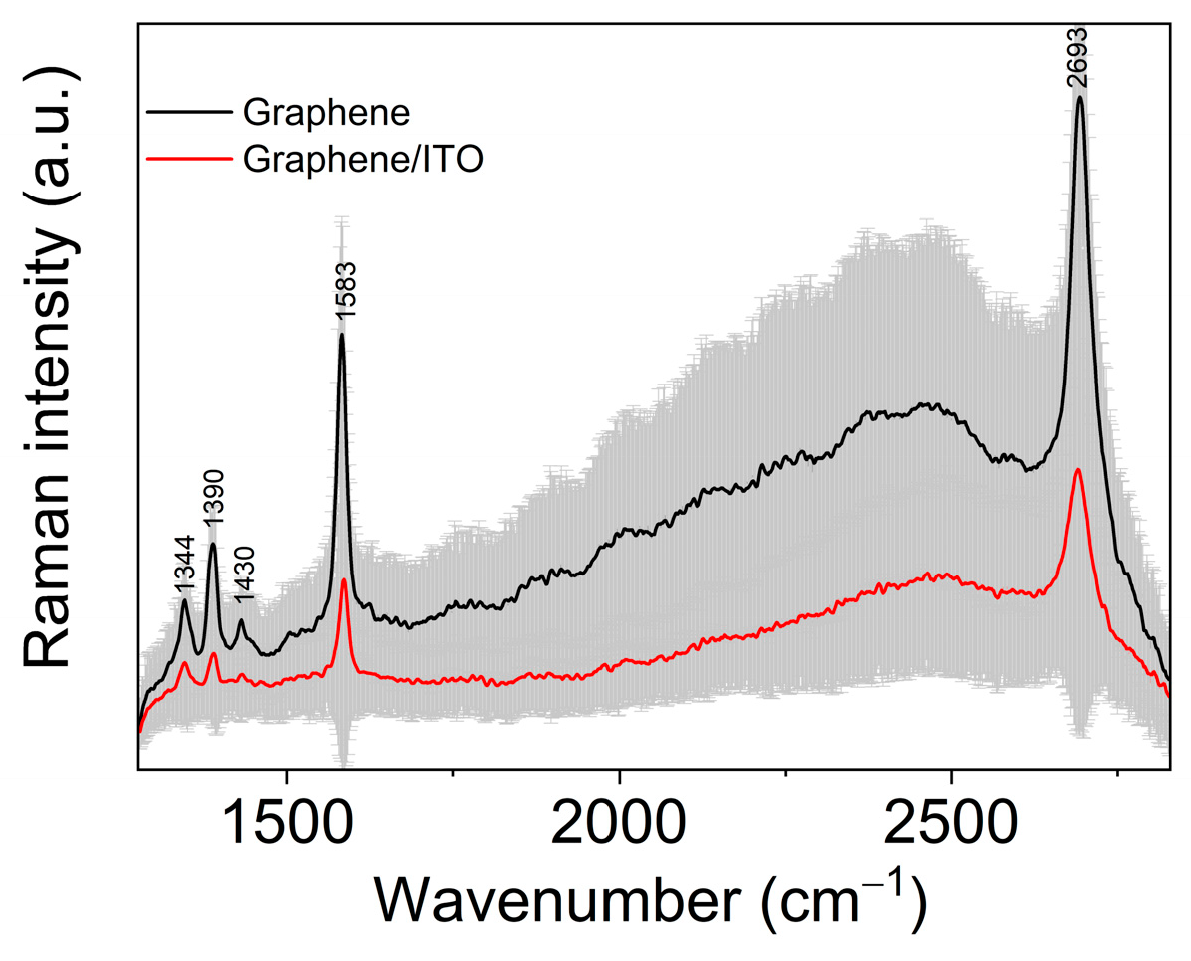
The Raman spectra of graphene deposited on glass (black curve) and ITO substrate (red curve). The grey shaded region represents the standard deviation calculated from 121 Raman spectra.
Enhanced Conductive Pathways Improve Charge Transport Performance
Raman spectroscopy confirmed the successful integration of graphene onto the ITO surface. The samples displayed characteristic Raman peaks near 1344 cm-1, 1583 cm-1, and 2693 cm-1 corresponding to the D, G, and 2D bands. The low intensity of the D band indicated minimal structural defects and high graphene quality. After transfer onto the ITO substrate, the G band showed a slight blueshift, while the 2D band shifted slightly toward lower frequencies.
These spectral changes were interpreted as evidence of charge-transfer interactions and carrier doping in the graphene–ITO hybrid structure. Additionally, the researchers observed only a small increase in the D/G intensity ratio after transfer, demonstrating that the graphene maintained good structural integrity during fabrication. In addition, the narrowing of the 2D peak suggested strong coupling between graphene and the ITO surface.
TUNA-AFM analysis revealed major differences in electrical transport behavior between bare ITO and graphene-coated ITO surfaces. Bare ITO films displayed localized conductive regions concentrated around polycrystalline grain boundaries, with tunneling currents ranging from approximately −950 fA to 940 fA. In contrast, graphene-coated ITO surfaces showed smoother textures and highly interconnected conductive pathways. Tunneling currents increased significantly to values between −1.6 pA and 1.5 pA, confirming enhanced nanoscale charge transport.
The researchers found an approximately 60% increase in maximum nanoscale tunneling current after graphene integration. They attributed the improvement to graphene’s excellent in-plane conductivity and strong interfacial coupling with ITO, which enhanced carrier mobility and vertical charge tunneling.
The study also confirmed uniform graphene coverage and reproducible electrical performance across the hybrid electrode surface. Overall, the results demonstrate that graphene significantly improves electrical continuity while maintaining the surface uniformity required for advanced transparent electrode applications.
Implications for Next-Generation Aerospace Energy Technologies
This research highlights the strong potential of graphene–ITO hybrid electrodes for advanced space photovoltaic systems. The researchers developed a highly conductive hybrid electrode structure by integrating graphene with conventional transparent conductive oxides, enabling efficient charge transport in multijunction solar cells.
The hybrid electrodes significantly improved nanoscale conductivity response without introducing major graphene defects during transfer or reducing local surface uniformity. These improvements may be important in aerospace applications, where solar cells must remain durable, highly efficient, and compatible with demanding operating conditions.
The improved nanoscale current response and relevance to transparent-electrode design also make graphene–ITO hybrid electrodes promising for broader optoelectronic and aerospace technologies.
Future research should focus on macroscopic measurements, device-level electrical and optical testing, long-term environmental stability, large-area reproducibility, and integration into operational solar cells.
Overall, the study demonstrates how graphene-based hybrid architectures can improve the materials-level charge-transport properties needed for next-generation energy technologies.
Download your PDF copy by clicking here.
Disclaimer: The views expressed here are those of the author expressed in their private capacity and do not necessarily represent the views of AZoM.com Limited T/A AZoNetwork the owner and operator of this website. This disclaimer forms part of the Terms and conditions of use of this website.
Source:
- Ahmed, N. ul A., et al. (2026). 2D Nanomaterial-Based Transparent Electrodes for Next-Generation III–V Multijunction Space Solar Cells. Engineering Proceedings 133(1). DOI: 10.3390/engproc2026133101, https://www.mdpi.com/2673-4591/133/1/101