The Bettersizer 2600 Plus combines laser diffraction technology with dual-camera dynamic imaging in a single modular platform, enabling the analysis of size and shape within a range of 0.02–3500 μm.
Laser diffraction delivers quick and dependable particle size distributions by employing a 92-detector array and Mie/Fraunhofer models.
Dynamic imaging captures rapid images of particles to assess size and shape, providing visual validation for agglomerates, irregular particles, and oversized tails.
This system accommodates a wide variety of wet and dry dispersion units, thanks to its modular design.
This flexibility allows for multiple configurations tailored to different sample types, volumes, and solvents, ensuring that a single instrument can cater to numerous applications and industries.
Features and Benefits
- Size and shape consolidated in a single platform: A combination of laser diffraction and dynamic imaging
- Wide range: 0.02–3500 μm appropriate for different materials and workflows
- Modular dispersion units: Flexible wet and dry setups for a variety of samples and solvents
Overview
Advance Technology
Bettersizer 2600 Plus – Particle Size and Shape Analysis for All Needs

Image Credit: Bettersize Instruments
Advanced Laser Diffraction System
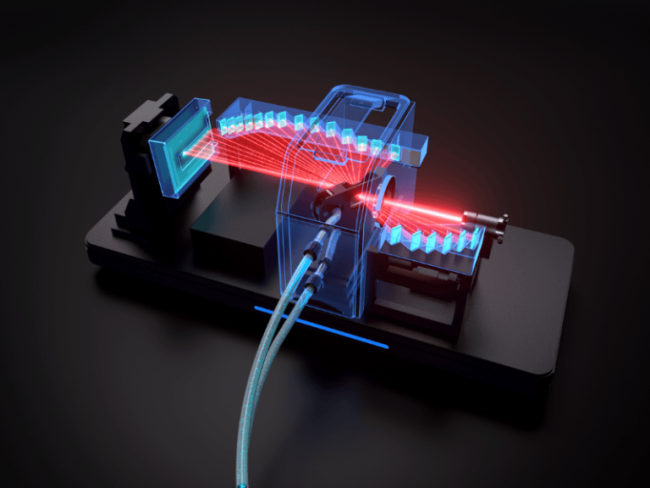
Image Credit: Bettersize Instruments
Wide-Angle Signal Collection for Reliable PSD
The Bettersizer 2600 Plus is designed to provide dependable and uniform particle size distributions over a broad measurement range by effectively capturing extensive scattering signals.
Its patented Fourier and inverse-Fourier optical system improves both signal acquisition and measurement reliability.
- A 92-detector array engineered for superior scattering detection
- Angular coverage extending from 0.016 ° to 165 ° for both fine and coarse particles
- A slanted sample cell design that reduces total internal reflection and improves signal use
Confidence for Optically Challenging Samples
For a variety of real-world samples, Mie-based sizing can be sensitive to unrecognized or varying optical properties.
The Bettersizer 2600 Plus features a patented ability to measure refractive index, thereby improving measurement reliability in difficult optical situations.
- Handle unfamiliar materials with increased confidence
- Verify optical data at the designated operational wavelength
- Enhance result reliability for optically complex samples
Superior Performance
The laser diffraction system ensures precise and reliable particle size measurements in compliance with ISO 13320, enabling diverse industries and applications to achieve improved performance standards.
- Cover a wide measurement range from 0.02–2600 μm
- Achieve precision greater than 0.5 %
- Ensure consistency better than 0.5 %
- Complete measurements in as little as 10 seconds
Dual-Camera Dynamic Imaging System
Modular Dual-Camera Imaging System
PIC-1 is a dual-camera dynamic imaging module intended for the real-time analysis of particle images.
It captures high-speed images of particles during measurements and converts them into data concerning size and shape, enabling both standalone imaging and integrated analysis with laser diffraction.
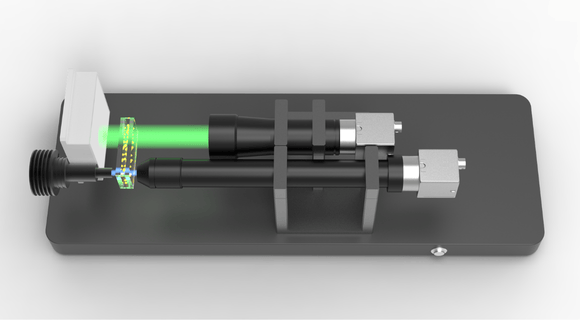
Image Credit: Bettersize Instruments
Size range: 2–3500 μm
Magnification: 0.5×, 10×
Modes: Imaging-only/Combined
Frame rate: 70 fps
Broadened Insight with Modular Imaging Expertise
Combined Size and Shape Characterization
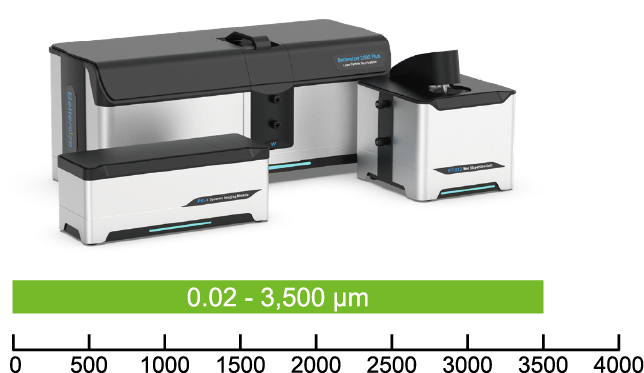
Image Credit: Bettersize Instruments
By employing PIC-1, laser diffraction, and dynamic imaging function within a unified wet-dispersion workflow, offering insights into both particle size and shape in a single measurement. This integrated setup improves the platform's ability to handle sizes up to 3500 μm.
Detection of Abnormal Particle
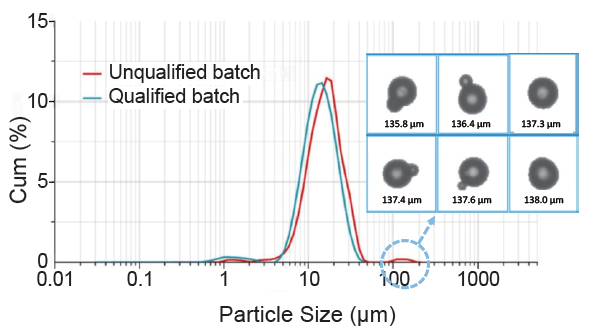
Image Credit: Bettersize Instruments
Imaging evidence assists in recognizing rare phenomena, including large particles, agglomerates, and bubbles, thus improving assurance in quality control and problem-solving.
Irregular Particle Characterization
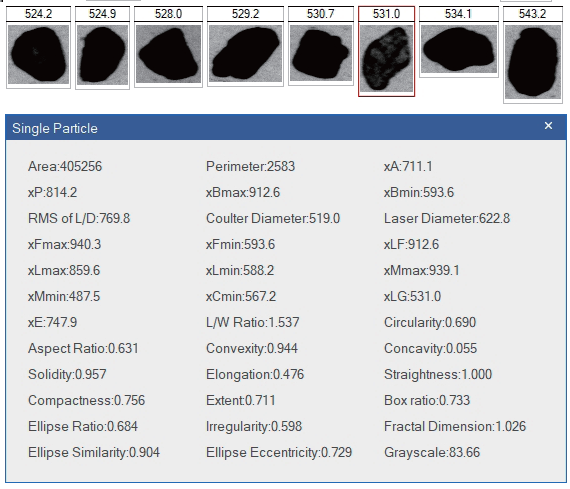
Image Credit: Bettersize Instruments
PIC-1 captures real-time images of particles to enable thorough single-particle analysis.
By offering data on up to 32 size and shape parameters, it enables a deeper comprehension of particle shapes and their attributes.
Traceability and Result Review
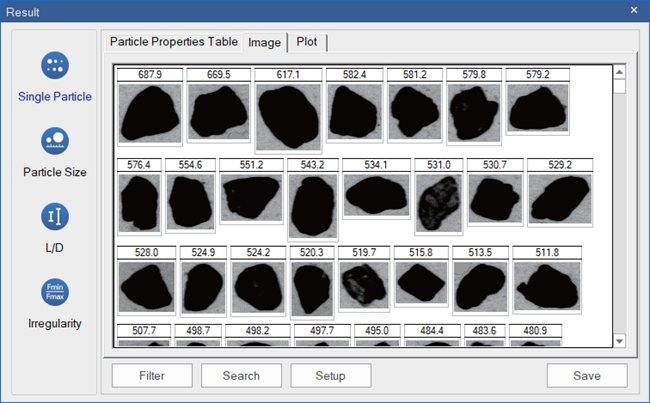
Image Credit: Bettersize Instruments
Particle images provide a reliable basis for evaluation and verification, supporting quality control, research and development, and applications that demand high reliability.
Specification
Source: Bettersize Instruments
| General |
| Principle |
Laser diffraction technology, Dynamic image analysis |
| Analysis |
Mie scattering theory, Fraunhofer diffraction theory, Dynamic image analysis |
| Data acquisition rate |
11 kHz |
| Typical measurement time |
Less than 10 seconds |
| Special functions |
Automatic surfactant addition, refractive index measurement, sample ratio calculation |
| Measurement performance |
| Measuring range* |
0.02–2600 μm (wet); 0.1–2600 μm (dry); 2–3500 μm (dynamic image) |
| Accuracy* |
≤ 0.5 % |
| Repeatability* |
≤ 0.5 % |
| Number of size classes |
100 (adjustable) |
| Main device |
| Optical system |
Laser diffraction system |
| Laser |
10 mW, 635 nm |
| Delector |
92 detectors |
| Measuring angle |
0.016–165 ° |
| Alignment |
Automatic |
| Dynamic imaging module |
| Optical system |
Dynamic imaging system |
| CMOS camera |
0.5x and 10x |
| Measuring range |
2–3500 μm |
| Frame rate |
70 fps at 5 MP |
| Compliance |
| Laser |
Class 1 (IEC60825-1 and 21CFR1040.10) |
| Regulatory |
RoHS, CE |
| Standards |
ISO 13320, ISO 13322-2, USP <429> |
| Software |
21 CFR Part 11 |
| System |
| Supply voltage |
100–240 VAC, 50/60 Hz |
| Dimensions (L × W × H) |
745 × 305 × 305 mm |
| Weight |
33 kg |
| Computer configuration (recommended) |
| Computer interface |
At least two high-speed USB 2.0 and two USB 3.0 ports required; |
| Operating system |
Windows 10 or higher |
| Hardware specification (recommended) |
Intel Core i5 Processor, 16 GB RAM, 512 GB SSD, 1920 × 1080 (Full HD) |
*Sample and sample preparation dependent
Dispersion Units
Bettersizer 2600 Plus Family
Wet Dispersion Units
Consistent Dispersion Workflow for Reliable Results
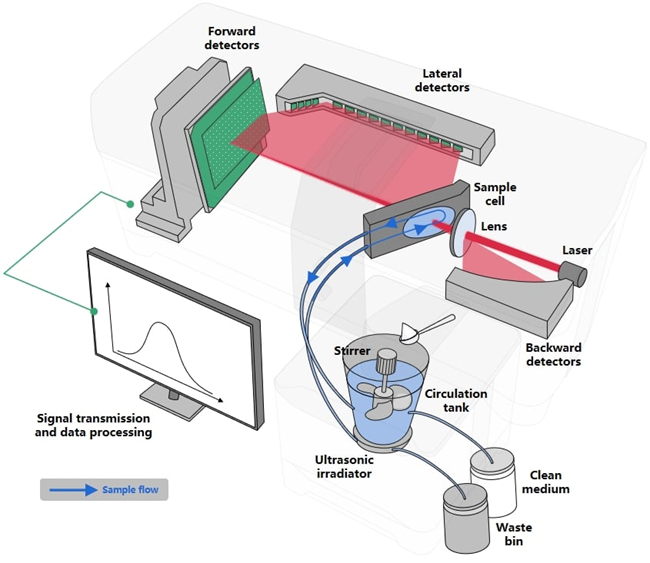
Image Credit: Bettersize Instruments
Wet dispersion introduces the sample into a selected liquid medium, such as water or an appropriate organic solvent, to form a stable suspension. A controlled workflow, typically defined by automated Standard Operating Procedures (SOPs), ensures that the dispersion conditions are maintained consistently.
Continuous circulation and stirring foster homogeneity, while integrated ultrasonic treatment disintegrates agglomerates and assists in the liberation of trapped air. Subsequently, the suspension passes through the optical measurement zone and is recirculated for uniform analysis.
The automated incorporation of surfactants further improves wetting and suspension stability, reducing re-agglomeration and enabling reliable, operator-independent outcomes.
Core Functions Across Wet Dispersion Units
Stirring and circulation: Ensure uniformity and reduce settling
Ultrasonic energy: Disperse particles and aid in the removal of trapped air
Surfactant addition: Improve wetting and ensure the stability of the suspension
BT-812 Automatic Wet Dispersion Unit
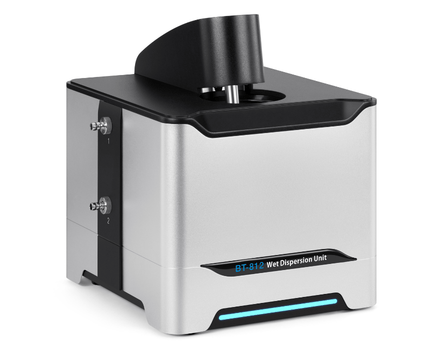
Image Credit: Bettersize Instruments
The majority of routine samples can be dispersed in water, making water-based wet dispersion the most prevalent workflow. In these scenarios, the BT-812 serves as the main wet dispersion unit for the Bettersizer 2600 Plus, integrating controlled circulation, ultrasonics, and automated liquid handling to provide consistent measurements.
- High-capacity circulation tank with a maximum volume of 500 mL
- Centrifugal circulation pump featuring adjustable speed
- 50 W ultrasonic dispersion system with adjustable settings and dry-run protection
- Fully automated liquid handling system that includes level monitoring and automatic addition of dispersants
- Comprehensive software control for dispersion, measurement, and cleaning processes
Source: Bettersize Instruments
| Parameter |
Specification |
| Measurement range* |
0.02–2600 μm |
| Stirring speed |
300–2500 rpm |
| Ultrasonic power |
50 W maximum |
| Volume |
500 mL maximum |
| Medium |
Water |
| SOP |
Yes |
| Dimensions (L × W × H) |
257 × 275 × 308 mm (L × W × H) |
| Weight |
11.5 kg |
| Component |
ABS housing
304 stainless steel tank
Silicone tubing
Centrifugal pump
Peristaltic pump
Ultrasonic disperser
Quartz sample cell
Pinch valve |
* Sample and sample preparation dependent
Automatic Surfactant Addition
- Automated surfactant dosing during dispersion
- Volume-regulated addition for uniform preparation
- SOP settings for consistent workflows
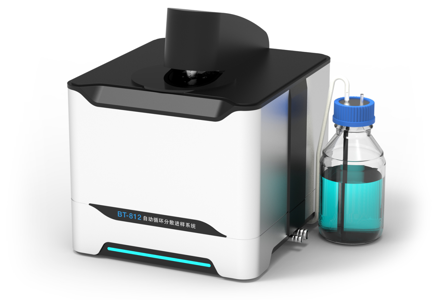
Image Credit: Bettersize Instruments
Easy-to-Remove Wet Sample Cell
- Toggle-lock system designed for rapid installation and removal
- Tool-free extraction for daily ease of use
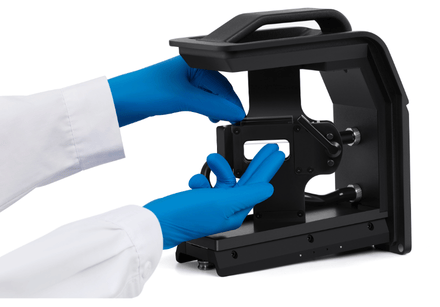
Image Credit: Bettersize Instruments
BT-80N Pro Automatic Anti-Corrosive Wet Dispersion Unit
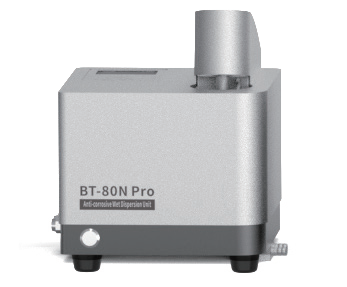
Image Credit: Bettersize Instruments
The BT-80N Pro is carefully engineered for wet dispersion processes that necessitate the use of organic solvents or corrosive substances. To fulfill these requirements, essential components are constructed from corrosion-resistant materials, thereby enhancing long-term compatibility and dependability.
- Broad compatibility with organic solvents
- Two operational modes: local panel control or software control
- Low-volume circulation tank: 80–120 mL
- 50 W ultrasonic dispersion that is adjustable and includes dry-run protection
- Centrifugal circulation pump featuring adjustable speed
- Comprehensive software control for dispersion, measurement, and cleaning processes
Source: Bettersize Instruments
| Parameter |
Specification |
| Measurement range* |
0.02–2600 μm |
| Stirring speed |
300–2500 rpm |
| Ultrasonic power |
50 W max |
| Volume |
80–200 mL |
| Medium** |
Water, organic solvent |
| SOP |
Yes |
| Dimensions (L × W × H) |
240 × 220 × 290 mm (L × W × H) |
| Weight |
9 kg |
| Key Component |
316L Stainless-steel housing
PTFE tubing
316 Stainless-steel diaphragm pump
316L Stainless-steel tank
Quartz sample cell
Ultrasonic disperser |
* Sample and sample preparation dependent
** Compatibility depends on the wetted materials.
BT-80N Anti-Corrosive Wet Dispersion Unit
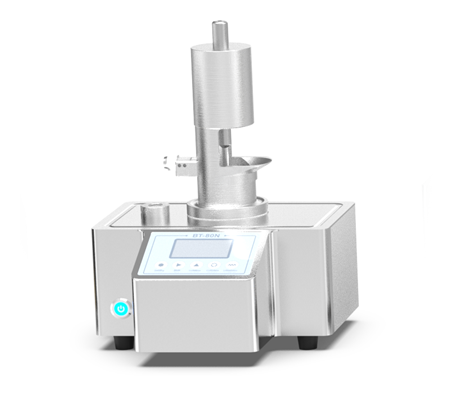
Image Credit: Bettersize Instruments
The BT-80N serves as an economical, introductory option that offers fundamental solvent compatibility for standard measurements.
- Wide compatibility with organic solvents
- Centrifugal circulation pump featuring adjustable flow
- 50 W adjustable ultrasonic dispersion equipped with dry-run protection
- Compact circulation tank: 50–80 mL
- Operational modes controlled via the local panel
Source: Bettersize Instruments
| Parameter |
Specification |
| Measurement range |
0.02–2600 μm |
| Stirring speed |
300–3000 rpm |
| Ultrasonic power |
50 W max |
| Volume |
50–80 mL |
| Medium |
Water, organic solvent |
| SOP |
No |
| Dimensions (L × W × H) |
290 × 210 × 375 mm (L × W × H) |
| Weight |
11 kg |
| Key Component |
316L Stainless-steel housing
PTFE tubing
316L Stainless-steel tank
Quartz sample cell
Ultrasonic disperser |
BT-814 Small-Volume Wet Dispersion Unit
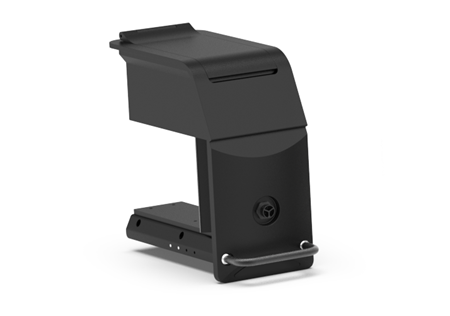
Image Credit: Bettersize Instruments
The BT-814 has been meticulously designed for situations where sample availability is limited or the material has a high level of value. It supports dispersion in both water-based and organic solvents, thus providing maximum versatility for a wide range of applications.
- Sample cell with a small volume: 8 mL
- Stirring is controlled to maintain stable dispersion conditions
- Compatibility with a wide range of dispersion media
Source: Bettersize Instruments
| Parameter |
Specification |
| Measurement range* |
0.02–2600 μm |
| Volume |
8 mL |
| Medium |
Water or organic solvent |
| SOP |
No |
| Dimensions |
/ |
| Weight |
/ |
| Key component |
ABS housing
Quartz sample cell
316L Stainless-steel stirrer |
* Sample and sample preparation dependent
Dry Dispersion Units
Controlled Deagglomeration for Repeatable Results
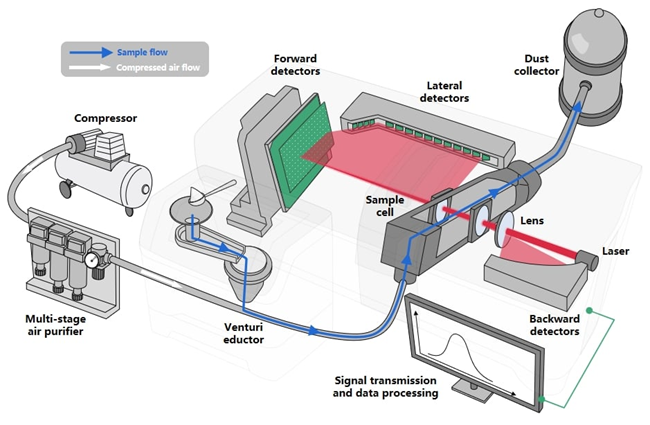
Image Credit: Bettersize Instruments
Dry dispersion is the process of introducing powdered samples into a system that uses gas as the medium. The sample is conveyed to the disperser through controlled vibrations.
Within the disperser, particles are driven by a precisely regulated high-pressure gas stream that flows through a Venturi device. Shear forces, collisions among particles, and particles colliding with the walls aid in the breakdown of agglomerates before measurement.
The stream of dispersed particles traverses the laser diffraction measurement area for analysis and is effectively evacuated and collected by a vacuum unit.
Shear forces: High-speed airflow efficiently disaggregates loosely connected agglomerates throughout the processes of acceleration and transportation.
Inter-particle collisions: Managed flow collisions promote deagglomeration and improve dispersion stability.
Particle-wall impacts: The effects that take place within the inlet pathway enhance the disintegration of agglomerates before measurement.
BT-912 Automatic Dry Dispersion Unit
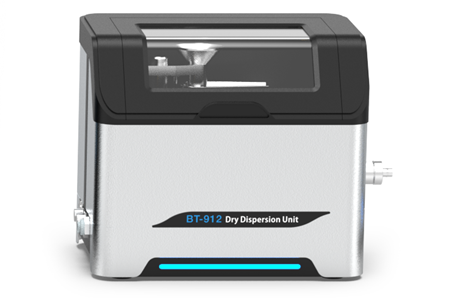
Image Credit: Bettersize Instruments
The BT-912 functions as the primary unit for dry dispersion of standard powders using compressed gas. It is capable of handling a wide variety of powders, including both friable and cohesive types.
Representative sampling: 0.2–10 g for standard laboratory analysis and quality control
Controlled feeding: The location of the adjustable hopper and the vibration frequency must be adjusted to guarantee the stabilization of obscuration.
Flexible gas supply options: Appropriate distribution for different dry powders
Fully automated sample feeding and cleaning: Improves effectiveness and consistency
Source: Bettersize Instruments
| Parameter |
Specification |
| Measurement range* |
0.1–2600 μm |
| Powder mass |
0.2–10 g |
| Gas pressure |
0.1–0.8 MPa |
| Funnel height |
0.7–2.9 mm |
| Medium |
Air, nitrogen, or noble gases |
| SOP |
Yes |
| Dimensions |
276 × 189 × 243 mm |
| Weight |
8 kg |
| Key Component |
304 Stainless-steel funnel
304 stainless-steel feeder
Venturi disperser
Vacuum cleaner (optional)
Air Compressor (optional) |
* Sample and sample preparation dependent
BT-903 Small-Volume Dry Dispersion Unit
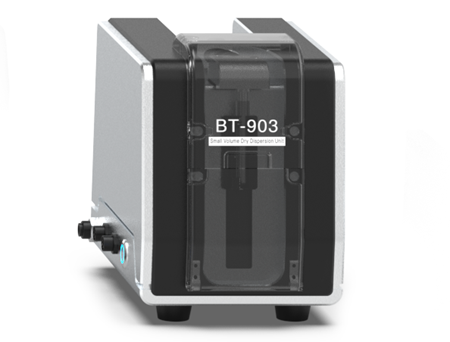
Image Credit: Bettersize Instruments
The BT-903 is a compact dry dispersion unit specifically designed for powder measurements when the amount of sample is limited. Initially, samples are placed into a tube and then introduced into the disperser via a controlled gas flow and negative-pressure suction, ensuring stable and consistent sampling.
Negative-pressure sampling: Regular small-scale feeding with a dosage sample between 0.02–1 g
Quick tube replacement: Minimizes carryover
Removable glass tube: Simplified maintenance and comprehensive sanitation
Fully automated feeding and cleaning: Improves efficiency and uniformity
Flexible gas supply options: Suitable dispersion for various dry powders
Source: Bettersize Instruments
| Parameter |
Specification |
| Measurement range* |
0.1–2600 μm |
| Powder mass |
0.02–1 g |
| Tube volume |
5 mL maximum |
| Gas pressure |
0.1–0.8 MPa |
| Medium |
Air, nitrogen, or noble gases |
| SOP |
Yes |
| Dimensions |
195 × 260 × 245 mm |
| Weight |
5 kg |
| Key Component |
Plastic sample tube
316 Stainless-steel tubing
Silicon tubing
Venturi disperser
Vacuum cleaner (optional)
Air Compressor (optional) |
* Sample and sample preparation dependent
Easy Module Selection
The Bettersizer 2600 Plus featuresa dynamic imaging module that increases the measurement range and carries out particle shape analysis, in addition to wet and dry dispersion units that perform efficient particle dispersion.
The module selection decision tree assists users in selecting the appropriate dispersion unit and assessing the necessity of the dynamic imaging module.
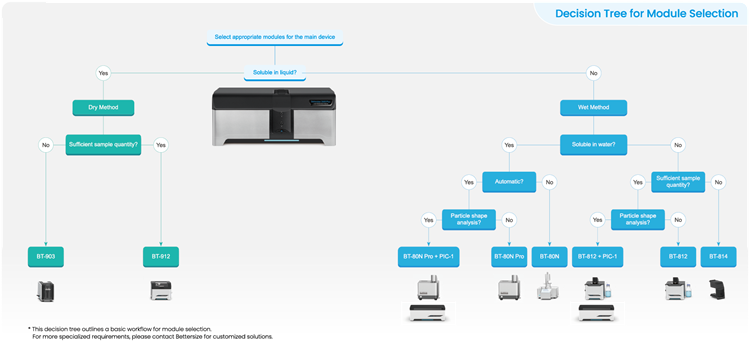
Image Credit: Bettersize Instruments
Software
Every step of the particle size measuring process, from sample preparation and measurement control to data analysis and report creation, is optimized by Bettersizer Software. Smoothly integrated with the Bettersizer 2600 Plus, it automates routine operations by means of a high level of automation, minimizing manual intervention while boosting productivity and output consistency.
- Real-time laser diffraction view: Updates the particle size distribution throughout the run while keeping an eye on obscuration and signal status
- Dynamic imaging window: Enables image-based testing to supplement size data with particle shape information
- Individual particle view: Offers an examination of collected particles at the image level
- Imaging size results: Show particle size distributions taken from images for extended coverage and confirmation
- Shape scatter plots: Help identify particle distribution and shape trends by visualizing size-shape connections
- Test record table: Arranges run history and important parameters for reporting, comparison, and traceability
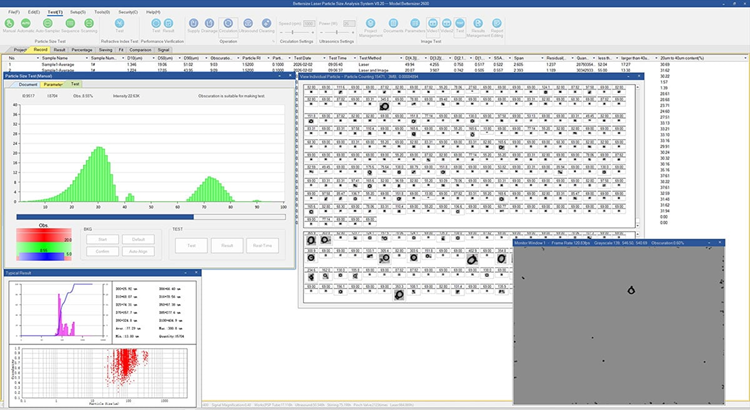
Image Credit: Bettersize Instruments
Smart Dispersion Control
The 'Auto Dispersion Setting' leverages real-time repeatability to automatically calculate the ideal dispersion time. It either chooses the optimal repeatability interval at the maximum time or quits when the user-specified repeatability target is reached.
SOP-Based Automation
Beyond simple stirring, ultrasonics, and circulation, SOPs standardize the entire process. In order to improve uniformity between operators and laboratories, automated tasks can include report production and printing, automatic dispersant addition, and autodilution to maintain target obscuration.
Flexible Measurement Modes
Particle size and shape characterization can be carried out in a single workflow by allowing users to choose between laser diffraction, dynamic imaging, or combined LD and imaging modes based on sample properties and reporting requirements.
Software Features Across the Testing Workflow
Automatic Pre-Processing
Users are easily able to create new tests based on dynamic image analysis techniques and laser diffraction. The software offers versatility for different sample types and testing settings by supporting both automatic and human control.
The SOP provides a simplified method for automated and standardized testing, guaranteeing consistent and dependable findings that are independent of the operator.
Automated System Preparation
By automating crucial instrument operations, including system cleaning, optical alignment, and sample dispersion, the Bettersizer software greatly improves data quality. These automated procedures guarantee the best possible instrument performance, which raises the accuracy, precision, and repeatability of the data.
Real-Time Testing
Bettersizer software provides real-time insights into particle size distribution and shape during testing. These instantaneous results offer important insights into the course and results of the test, allowing for accurate modifications to attain the best possible outcomes.
Data Evaluation and Reporting
When it comes to providing thorough data analysis and report production capabilities, the Bettersizer software excels. Using a variety of data points, charts, and graphical representations, the software enables users to modify and personalize reports to satisfy particular needs and produce understandable and instructive reports. The quality of the results can be evaluated with the aid of data evaluation tools.
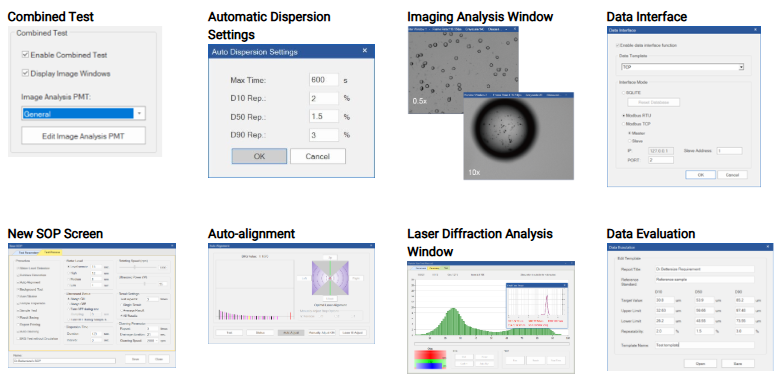
Image Credit: Bettersize Instruments
Reporting and Data Export
Highly Customizable Report
- Complete and comprehensive data: Cumulative and frequency distribution curves, a simple and comprehensive distribution table, etc.
- Easy to edit: A report's font, layout, format, and other elements can all be readily altered by users.
- Convertibility: Reports can be freely converted between PDF, Excel, Text, and other formats.
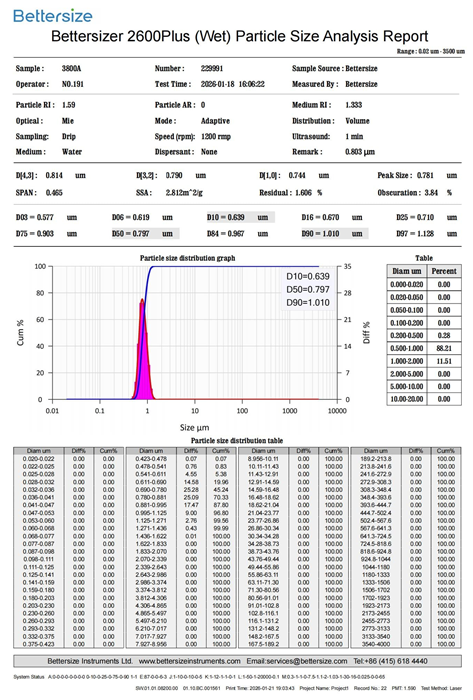
Image Credit: Bettersize Instruments
Videos
How to Perform Dry Particle Size Analysis with Bettersizer 2600 Plus + BT-912 Tutorial
How to Perform Dry Particle Size Analysis with Bettersizer 2600 Plus + BT-912 Tutorial. Video Credit: Bettersize Instruments
How to Measure Corundum Particle Size Using Bettersizer 2600 Plus + BT-812 Wet Dispersion Unit
How to Measure Corundum Particle Size Using Bettersizer 2600 Plus + BT-812 Wet Dispersion Unit. Video Credit: Bettersize Instruments
Fundamentals of Bettersizer 2600 Plus | All-in-One Particle Size and Shape Analyzer
Fundamentals of Bettersizer 2600 Plus | All-in-One Particle Size and Shape Analyzer. Video Credit: Bettersize Instruments
Bettersizer 2600 Plus Overview | All-in-One Particle Size and Shape Analyzer
Bettersizer 2600 Plus Overview | All-in-One Particle Size and Shape Analyzer. Video Credit: Bettersize Instruments
Snippet - How to Measure Particle Size of Coffee Powder
Snippet - How to Measure Particle Size of Coffee Powder. Video Credit: Bettersize Instruments
How to Measure Particle Size of Cosmetics
How to Measure Particle Size of Cosmetics. Video Credit: Bettersize Instruments
How to Measure Particle Size of Coffee Powder
How to Measure Particle Size of Coffee Powder. Video Credit: Bettersize Instruments