A green nanotechnology approach uses few-layer MoS2 nanosheets to transform ordinary nonwoven fabric into a pressure-sensitive smart textile, pointing toward washable, cytocompatible wearable sensors for future health monitoring.
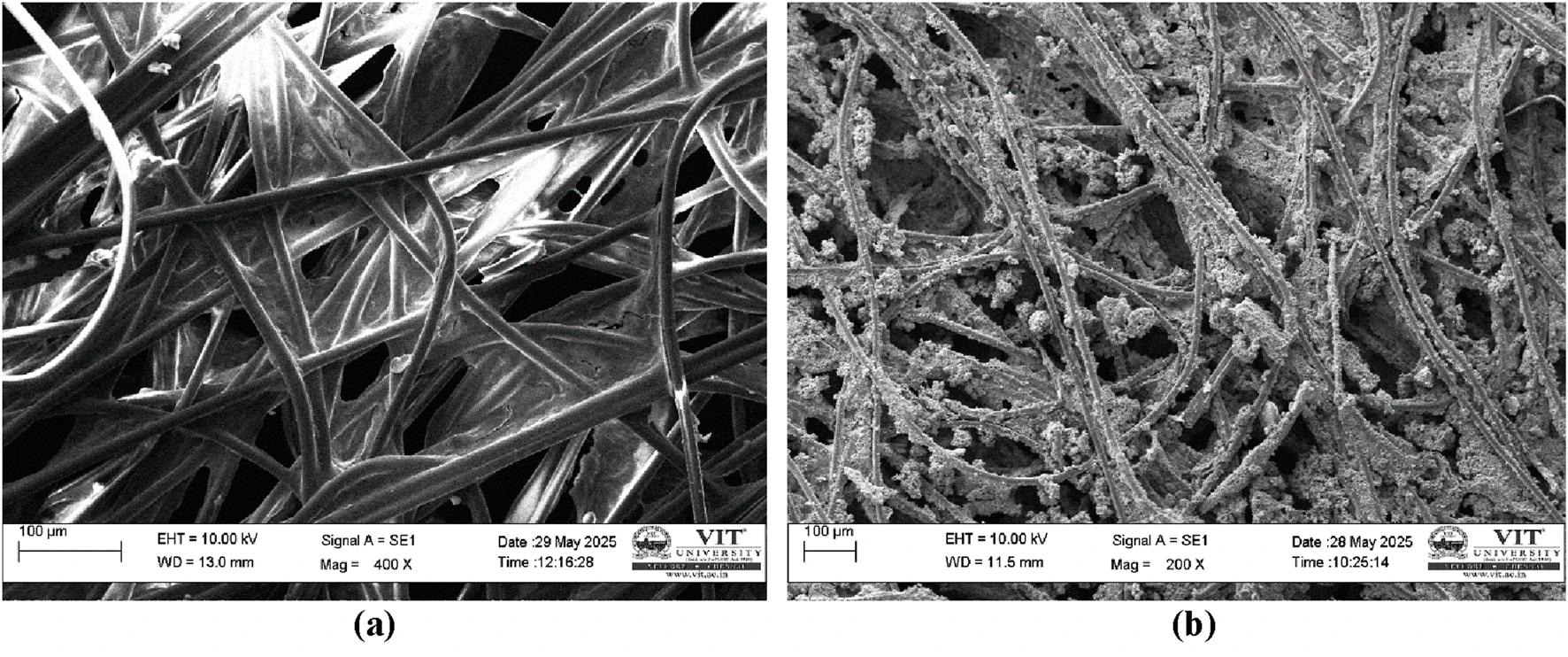
Scanning electron microscopy (SEM) and energy-dispersive X-ray spectroscopy (EDX) analysis. (a) SEM image of pristine nonwoven fabric showing clean, smooth fiber surfaces. (b) SEM image of MoS2-coated fabric displaying conformal coating of granular MoS2 nanosheets on fiber surfaces.
In a recent article published in the journal Frontiers in Nanotechnology, researchers developed a green-engineered, MoS2-functionalized nonwoven fabric that serves as a washable, biocompatible, and pressure-sensitive smart textile for wearable and biomedical applications.
Smart Textile Motivation
The rapid integration of smart textiles and wearable electronics into daily life necessitates materials that combine comfort, durability, and multifunctionality. Among these, pressure-sensitive fabrics that can reliably monitor biomechanical signals are increasingly vital for healthcare and fitness applications. However, challenges remain in developing scalable fabrication methods that couple high sensitivity, mechanical robustness, and biocompatibility, especially when using nanomaterials.
MoS2 is a layered transition metal dichalcogenide widely studied for its unique electronic, optical, and mechanical properties at the nanoscale. Its semiconducting nature and layered structure enable reversible interlayer responses under mechanical stimuli, making it a prime candidate for piezoresistive sensing. Traditional methods for exfoliating and applying MoS2 nanosheets often rely on toxic solvents, limiting scalability and biomedical applicability.
Green Synthesis Process
The core nanoengineering approach involves liquid-phase exfoliation of bulk MoS2 powder in a 1:1 ethanol-water mixture containing 0.1 M citric acid. Citric acid plays multiple roles at the molecular level: it intercalates between MoS2 layers by complexation and electrostatic repulsion aided by its carboxylate (-COOH) groups, facilitating delamination during sonication.
This process yields few-layer MoS2 nanosheets with high colloidal stability, suppressing restacking and enabling uniform coating. The nanosheet suspension was then used to soak cleaned nonwoven fabric substrates for one hour to deposit a uniform conductive nanosheet network. After drying, the MoS2 coating thickness averaged 1.42 μm, with a nanosheet loading of about 7.2 mg/cm².
The nanoscale morphology, phase, and structural integrity of the coated fabrics were characterized by atomic force microscopy (AFM), scanning electron microscopy (SEM), X-ray diffraction (XRD), Raman spectroscopy, and electrical measurements, ensuring the preservation of few-layer, semiconducting MoS2 on the textile fibers.
The sensor design employed a sandwich configuration with two MoS2-coated fabric layers separated by a conductive polyethylene-carbon film to create a piezoresistive device. Applying pressure modulated the interlayer contact and electrical pathways at the nanoscale, leading to measurable changes in resistance.
Pressure-sensing performance was assessed over 600 to 6,000 Pa, along with durability under cyclic loading, washability, temperature-dependent electrical behavior, and biological compatibility through in vitro tests.
Sensor Performance Analysis
AFM analysis revealed a flaky, textured MoS2 nanosheet composite on the fabric, with nanosheet aggregates creating height variations up to 2-3 μm and an RMS roughness of approximately 400 nm. This topography facilitates strain-induced sliding and reorganization of nanosheets at their junctions, which enhances piezoresistive sensitivity. The few-layer nanosheet structure (three to five layers confirmed by Raman) provides a balance between conductivity and mechanical flexibility, which is crucial for wearable sensors.
Electrical characterization using a four-point probe method showed a dramatic decrease in fabric resistance after MoS2 coating, transitioning from an insulating substrate with sheet resistance ~2.5 × 10¹0 Ω/sq to a conductive network with resistance on the order of kilo-ohms. The citric acid-assisted exfoliation resulted in a more uniform nanosheet percolation network, despite a slightly higher sheet resistance than in coatings without citric acid.
This indicates a fundamental shift in the conduction mechanism from localized clusters to continuous nanoscale pathways, improving sensor stability and repeatability under mechanical deformation.
The fabricated sensors exhibited a competitive sensitivity of <2 kPa-¹ in the 0.6-6.1 kPa pressure range, with excellent reproducibility (coefficient of variation <2%) and low hysteresis (1-2%). The semiconducting MoS2 layers undergo reversible interlayer contact modulation under compression, leading to a monotonic decrease in resistance and an increase in voltage that correlate with the applied load. The device also showed systematic temperature-dependent electrical responses from 30 °C to 100 °C, including negative-temperature-coefficient behavior, adding another performance metric relevant to textile sensor benchmarking.
Biological assessments highlighted the dual functionality of the MoS2-coated fabrics at the nanoscale. The coating maintained 79.97% cell viability at 100 μg/mL, passed ISO 10993-5 cytocompatibility thresholds, and exhibited qualitative antibacterial activity against common pathogens, Escherichia coli and Staphylococcus aureus.
These properties stem from the nanosheet surface chemistry and morphology, supporting its potential for future skin-contact wearable applications, pending further testing under real-use conditions. The sensor maintained functional electrical performance through up to 7 washing cycles, although resistance increased substantially, and wash-induced degradation warrants further study.
Wearable Application Outlook
This study successfully engineered a pressure-sensitive smart textile by green synthesis and uniform deposition of few-layer MoS2 nanosheets onto a nonwoven fabric using a citric-acid-assisted exfoliation process.
The MoS2-functionalized fabric combines excellent sensing performance with mechanical stability, wash durability, temperature-responsive electrical behavior, and dual biofunctionalities of cytocompatibility and antibacterial activity. These attributes highlight the potential for future integration into wearable health monitoring systems after further validation. The environmentally friendly green synthesis not only avoids toxic solvents but also enables energy-efficient processing suitable for scale-up.
Future work is encouraged to explore long-term cycling, wash-induced nanoscale changes, sweat and humidity effects, and on-body trials to propel the technology toward commercial and clinical use. By bridging the material-process-application gap with a focus on nanomaterials, this research significantly advances sustainable, multifunctional wearable electronics for personalized healthcare.
Download your PDF copy by clicking here.