PI (Physik Instrumente) is expanding the capabilities of its Bi-Phase Inertia Drive (BIX) technology with new motor architectures designed for compact, high-precision nanopositioning applications. Building on the technology behind the B-421 BIX nanopositioning stages, PI engineers have demonstrated new developments for higher-force linear motion, rotary positioning, micrometer screw drives, tip/tilt motion, and cryogenic environments.
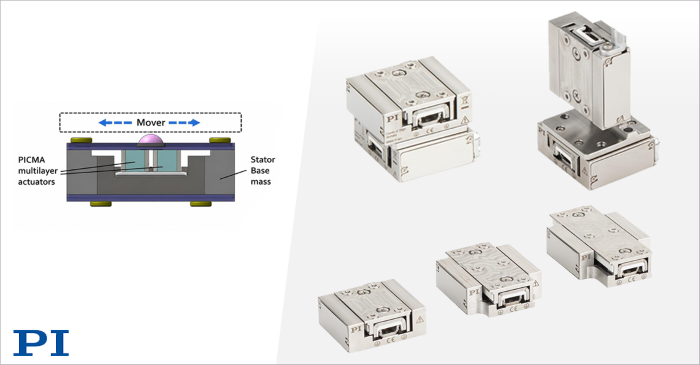 PI's B-421 BIX miniaturized piezo stages provide 10 nm positioning resolution in an extremely compact package. X, XY, XZ, and XYZ combinations are available, with travel ranges from 13 to 33 mm. Image Credit: PI (Physik Instrumente) LP
BIX bi-phase positioning stages are based on the stick-slip principle used in piezo inertia motors but employ two synchronized multilayer piezo actuators rather than a conventional single-actuator design. The PICMA® actuators are driven by mirrored sawtooth signals, with one actuator expanding while the other contracts. Their combined motion reduces the effects of piezo hysteresis and increases acceleration at the friction contact point.
The result is a compact drive architecture that provides precise, repeatable motion while maintaining the self-locking characteristics of piezo inertia motors. The B-421 BIX miniature linear stages, for example, provide 10 nm minimum incremental motion, 6 nm encoder resolution, travel ranges from 13 to 33 mm, and velocities up to 14 mm/s. The stages can also be combined into multi-axis configurations for space-constrained OEM systems.
Extending BIX to New Applications
PI’s recent BIX development work demonstrates how the same bi-phase drive principle can be adapted to different mechanical architectures and performance requirements.
- High-force BIX uses a two-sided stator with two friction contacts to approximately double the drive force of the standard one-sided design
- BIX micrometer screw drives convert the microscopic motion of the piezo actuators into rotation of a drive screw, reducing friction losses and increasing available force compared to conventional inertia screw-drive mechanisms.
- 2D-BIX combines four PICMA® piezo stacks with a lever structure to produce two-axis motion. The concept has been demonstrated in a mirror tip/tilt platform and can operate in both stepping and analog modes.
- Rotary BIX uses dual-sided stators to drive miniature rotary platforms, extending the technology to compact rotational positioning applications.
BIX designs have also been adapted for cryogenic operation, including a flexure-guided linear stage prototype. Together, these developments demonstrate the potential to scale the BIX architecture across different motion requirements while retaining the core advantages of the bi-phase drive principle.
For OEM customers, the technology provides a platform for compact high-precision positioning mechanisms where conventional motorized stage designs may be constrained by available space, holding requirements, or mechanical complexity.
Applications and Industries Served
Demonstrated applications include photonics, laser and optical alignment, metrology, microscopy, semiconductor instrumentation, and other precision systems.