Sponsored by HORIBAMay 22 2008
The analysis of molecular interactions is a key area of research in the healthcare, pharmaceutical and biotechnology fields. Molecular recognition at solid surfaces forms the basis of a large number of bio and immunosensor diagnostic devices.
A biosensor is an analytical device that uses biological molecules to detect other biological molecules or chemical substances. Typically the detector molecule must be connected to a sensor that can be monitored by a computer, which converts the biological systems with the computing power of the microprocessor.
How Does A Biosensor Work?
A biosensor consists of 3 parts:
- The sensitive biological element (biological material e.g. tissue, microorganisms, organelles, cell receptors, enzymes, antibodies, nucleic acids etc.), a biologically derived material or biomimic). The sensitive elements can be created by biological engineering.
- The transducer in between (associates both components).
- The detector element (works in a physicochemical way; optical, piezoelectric, electrochemical, thermometric, or magnetic).
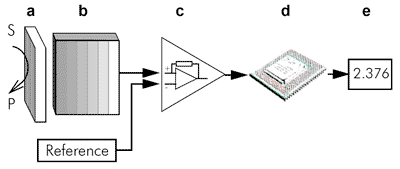
Figure 1. Schematic diagram showing the main components of a biosensor. This device consists of: (a) a biocatalyst that converts the substrate to product; (b) the transducer that determines the reaction and converts it to an electrical; and the signal output is (c) amplified, (d) processed, and (e) displayed.
Introduction to the Biotin Avidin System
There are many potential application of biosensors of various types. The main requirements for a biosensor approach to be valuable in terms of research and commercial applications are the identification of a target molecule, availability of a suitable biological recognition element, and the potential for disposable portable detection systems to be preferred to sensitive laboratory-based techniques in some situations. Some examples are given below: glucose monitoring in diabetes patients <-- historical market driver, other medical health related targets, environmental applications e.g. the detection of pesticides and river water contaminants, remote sensing of airborne bacteria e.g. in counter-bioterrorist activities, detection of pathogens...
The key goal in the development of such devices is the immobilization of proteins onto the transducer element in such a way as to keep maximum biochemical activity and minimum non specific interactions.
Avidin is a glycoprotein found in egg white. Biotin is a member of the B-vitamin family, also known as vitamin-H.
The biotin-avidin system plays a major role in these applications as it exhibits highly specific and strong binding affinity. Another distinctive advantage of this system are the four identical binding sites of avidin for biotin ensuring that the binding is directed only to the target of interest.
Adsorbing biotin on solid surfaces and assembling avidin makes it possible to attach active ligands to the biosensor surface, thereby identifying target species in the sample and increasing the selectivity of the biosensor by reducing interferences from non-specific interactions.
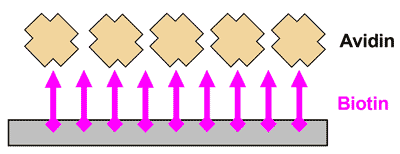
Figure 2. Schematic of the formation of the biotin-avidin complex
When specific species come into contact with the avidin/ biotin surface and bind to it there is an increase in the thickness of the deposited film. By measuring an increase in the film thickness one can tell if a biomolecule has bound to the sensor surface. The thickness increase is small, typically of the order of 20 Å, requiring a sensitive and reliable technique for the measurement.
Such a technique is Spectroscopic Ellipsometry (SE), a non destructive and very accurate technique to detect ultra-thin layers as well as investigate the interactions that can happen at the solid-liquid interface. A major advantage of the technique is that investigations can be made in ambient air, liquid or vacuum environment.
Experimental
Ellipsometric data were collected at an angle of incidence of 70° using the UVISEL Spectroscopic Phase Modulated Ellipsometer from Horiba across the spectral range 260-830 nm. The combination of the phase modulation technology of the UVISEL and its modular design makes it a powerful tool for biofilm measurement.
Characterization of c-Si/Biotin
A biotin film was deposited on the silicon substrate and is represented by a single layer. The measurement was performed in ambient air environment, the sample is simply placed on the sample stage to perform the non-destructive measurement.
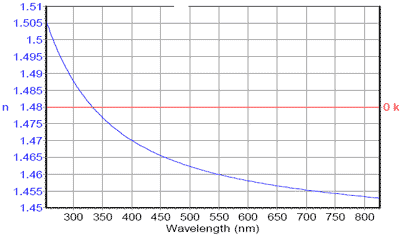
Figure 3. Biotin Optical Constants
Characterization of c-Si/Biotin-Avidin Complex
The measurement was performed in a liquid environment; the sample is placed in a liquid cell filled with demineralised water. A single layer was used to model the sample. We made the hypothesis that the refractive index of the biotin film and the biotin-avidin complex was the same. The increase of the thickness found shows the strong binding affinity of the biotin-avidin system.
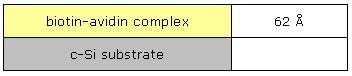
The figure below shows the excellent agreement between the experimental data and the model.
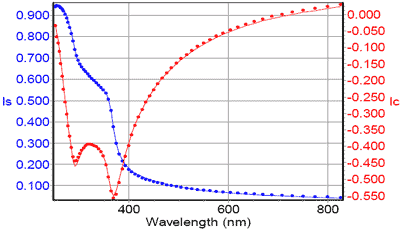
Figure 4. Experimental and generated data
Conclusion
This application note illustrates the suitability of the UVISEL Spectroscopic Phase Modulated Ellipsometer as a very accurate instrument for studying solid/solid or solid/liquid interface reactions, and measurement of biofilm thickness.

This information has been sourced, reviewed and adapted from materials provided by HORIBA.
For more information on this source, please visit HORIBA.