Aug 10 2009
Specialty chemicals group LANXESS AG has developed a polymer additive for plastics and rubber that is now available for industrial application. These microgels, which consist of nanoscale organic particles, can be used to improve the material properties of elastomer and thermoplastic materials.
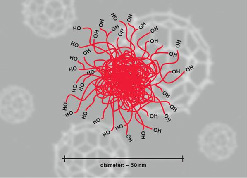
In the course of the product’s many years of development, the LANXESS Technical Rubber Products and Rhein Chemie business units have worked together closely and applied for numerous patents. These cover the processing method, the use of nanoparticles in rubber mixtures and the impact on thermoplastic and thermoset polymers. The Technical Rubber Products business unit markets these nanoscale particles under the registered trademark Nanoprene, while Rhein Chemie Rheinau GmbH sells the additive under the brand name Micromorph. After close co-operation between Rhein Chemie company and the Japanese tire manufacturer Toyo Tire & Rubber Co. Ltd., the first major series application of the rubber additive is in the production of winter tires. These tires boast excellent dry and wet road grip, without the tire rubber hardening on contact with snow or ice.
Tire technology – improved performance
Different Nanoprene grades can be used to satisfy different requirement profiles for tires (e.g. summer and winter tires) and various tire components (tread, side wall, carcass, etc.) in line with their glass transition temperature.
The physical properties of rubber give rise to a conflict of objectives – also known as the magic triangle of tire technology – between certain parameters of the rubber. For example, improving wet grip in the past was only achieved at the cost of higher rolling resistance and, therefore, greater fuel consumption. Using the new nanoparticles as an additive can improve all three properties of the magic triangle – wet grip, rolling resistance and service life of tires – without having to make compromises.
In practice, comprehensive tests conducted by LANXESS have shown that using Nanoprene in summer tires, for example, improves dry road grip by between 10 and 15 percent. What’s more, adding Nanoprene also improves the stiffness of the tread blocks, which has a positive impact on the cornering properties under aquaplaning conditions. The abrasion resistance of tire treads containing Nanoprene is also much higher than those based on standard silica mixtures. The test results show that Nanoprene increases the service life of tires significantly.
Manufacture and delivery forms
In principle, Nanoprene consists of pre-crosslinked rubber particles that are manufactured by LANXESS in an innovative patented emulsion process. Different conditions can be achieved during the synthesis process, e.g. in terms of the degree of crosslinking (glass transition temperature) or polarity of the particles, depending on the required application. With particle sizes ranging between 40 and 200 nanometers, Nanoprene has a large specific surface area, which leads to improved distribution and joining of the silica filler to the polymer matrix.
After the manufacturing process, the rubber additive is available in the usual delivery forms such as bales, granules, powders, pastes and master batches. These additives are very similar to many other elastomers in terms of appearance and consistency, and they can be processed in the usual way. Special processes ensure that the particles disperse easily when used by customers.