Aug 19 2009
Scientists have discovered the secret to easing one of the great frustrations of the millions who use smart phones, portable media players and other devices with touch- screens: Reducing their tendency to smudge and cutting glare from sunlight. In a report today at the 238th National Meeting of the American Chemical Society, they describe development of a test for performance of such smudge- and reflection-resistant coatings and its use to determine how to improve that performance.
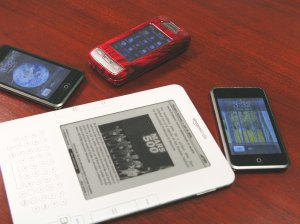 Scientists have developed a test for evaluating and improving the performance of smudge- and glare-resistant screens used in smart phones, portable media players and other devices. Credit: The American Chemical Society
Steven R. Carlo, Ph.D., and colleagues note in the new study that consumer electronics companies value the appearance of their flagship devices just as much as their functionality. As a result, smudge, scratch and reflective resistant coatings have become standard on high-end touch-screen cell phones and MP3 players. These coatings are effective. However, their structure and mechanisms are poorly understood, so Carlo and colleagues developed a test to determine the chemical composition and effectiveness of smudge and reflective resistant materials. The test could also lead to a better understanding of the chemistry of these coatings and allow improved formulations and performance, Carlo says.
“Surfaces are particularly important in consumer products. This work investigates how products can be modified to reduce smudging and reflections. These modifications can offer improved resistance to fingerprints, anti-reflection properties or enhanced physical resistance,” Carlo explains.
The basis of anti-smudge coatings is a compound called perfluoro alkyl ether, a derivative of Teflon with added ether groups to enhance its repellent effects. Anti-reflective materials use alternating layers of material, including silica and aluminum layers, to bend and diffuse light to reduce glare.
Since traditional chemical techniques could not be used on these super-thin coatings, Carlo and his team used depth profile X-ray photoelectron spectroscopy (XPS). That’s a tool for comparing the chemistry of these coatings to predict their performance. The data allowed them to compare chain length, degree of branching and the hydrocarbon and fluoroether content of various samples. The fluoroether content has a key effect in enhancing efficacy. Anti-reflective coatings need alternating layers, which have differences in their refractive index (RI), a measure of how fast light travels through a material. Fluorocarbons in general have low RI and they offer anti-smudge properties. XPS allowed the scientists to visualize the multi-layer structure and the chemical species present in each layer. In general, the greater the number of layers there are in a coating, the greater the anti-reflective properties. Carlo and his team also discovered that more silica and aluminum layers led to better glare reduction.