Oct 7 2009
Australian scientists have found that the bacterium Cupriavidus metallidurans catalyses the biomineralisation of gold by transforming toxic gold compounds to their metallic form using active cellular mechanism.
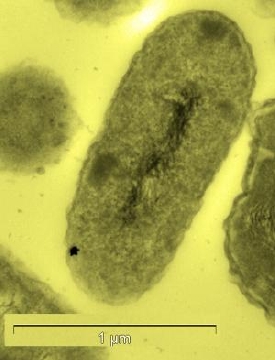 A C. metallidurans ultra-thin section containing a gold nanoparticle. (Credit: Reith et al, PNAS 5-9 October 2009.)
Researchers reported the presence of bacteria on gold surfaces but have never clearly elucidated their role. Now, an international team of scientists has found that there may be a biological reason for the presence of these bacteria on gold grain surfaces.
“A number of years ago we discovered that the metal-resistant bacterium Cupriavidus metallidurans occurred on gold grains from two sites in Australia. The sites are 3500 km apart, in southern New South Wales and northern Queensland, so when we found the same organism on grains from both sites we thought we were onto something. It made us wonder why these organisms live in this particular environment. The results of this study point to their involvement in the active detoxification of Au complexes leading to formation of gold biominerals,” explains Frank Reith, leader of the research and working at the University of Adelaide (Australia).
The experiments showed that C. metallidurans rapidly accumulates toxic gold complexes from a solution prepared in the lab. This process promotes gold toxicity, which pushes the bacterium to induce oxidative stress and metal resistance clusters as well as an as yet uncharacterized Au-specific gene cluster in order to defend its cellular integrity. This leads to active biochemically-mediated reduction of gold complexes to nano-particulate, metallic gold, which may contribute to the growth of gold nuggets.
For this study scientists combined synchrotron techniques at the European Synchrotron Radiation Facility (ESRF) and the Advanced Photon Source (APS) and molecular microbial techniques to understand the biomineralisation in bacteria. It is the first time that these techniques have been used in the same study, so Frank Reith brought together a multinational team of experts in both areas for the success of the experiment. The team was made up of scientists from the University of Adelaide, the Commonwealth Scientific and Research Organization (CSIRO), the University of California (US), the University of Western Ontario and the University of Saskatchewan (Canada), Martin-Luther-Universität (Germany), University of Nebraska-Lincoln (US), SCK.CEN (Belgium) and the APS (US) and the ESRF (France).
This is the first direct evidence that bacteria are actively involved in the cycling of rare and precious metals, such as gold. These results open the doors to the production of biosensors.
“The discovery of an Au-specific operon means that we can now start to develop gold-specific biosensors, which will help mineral explorers to find new gold deposits. To achieve this we need to further characterize the gold-specific operon on a genomic as well as proteomic level. If funding for this research is granted I believe we can produce a functioning biosensor within three to five years,” concludes Reith.
Posted on October 8th, 2009