Nov 2 2009
If you keep twisting a straight elastic string, at some moment it starts kinking in a wild way. Something similar occurs when one increases the electrical current flowing in a magnetized plasma doughnut: it takes on a wild helical shape, which spoils its performance. This phenomenon concerns scientists exploring fusion power, who use powerful magnetic fields to confine plasma during their experiments.
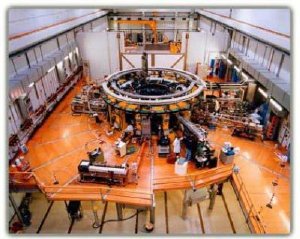
But a discovery made in the RFX-mod Reversed Field Pinch (RFP) fusion device demonstrated that if one keeps on increasing the current, above 1.5 million amperes, the helix becomes very smooth, the trapping of the plasma in the magnetic fields improves and the plasma gets hotter. Moreover, the helical state appears to be the preferred one at high current and is spontaneously chosen, or self-organized, by the plasma. RFX is a large RFP device (ten cubic meter plasma) located in Padova, Italy.
In the past, RFP experiments suffered from poor stability, which reduced confinement performance due to magnetic turbulence. But as a result of increased order in the self-organized helical state, magnetic confinement improves and a broad zone of the plasma becomes hot. This renews the fusion prospects of the RFP device, a magnetic confinement configuration germane to the tokamak (which uses a magnetic torus for plasma confinement) because a current flows in the plasma doughnut, and to the stellarator (which uses a magnetic helix) because the plasma takes on a helical shape.
An attractive feature of the RFP fusion device is that most of its magnetic field is produced by the current flowing in the plasma. This eliminates many of the costs and technical difficulties associated with producing strong magnetic fields using high-tech superconducting coils, such as those used in tokamak and stellarator fusion containment designs. The helical shape of the plasma comes with an additional bonus: the current lines are also helical. This greatly increases the length of the electrical circuit with respect to the tokamak. This could make reaching thermonuclear temperatures possible with only the electric power dissipated in the plasma. In principle, no additional heating is necessary—an additional positive economic and technical feature.
The remarkable helical shape of the plasma doughnut is the signature of self-organization dynamics. Similar helical structures may be found in astrophysical objects as well as living things, where self-organization provides stability and resilience against external perturbations. This should lead the RFP to be free of the disruptions that threaten tokamak discharges, where the plasma ring suddenly becomes a wild helix that damages the confinement vessel with heat fluxes and electromagnetic forces.
To confirm their relevance for thermonuclear fusion, RFX helical plasmas should be further improved, especially in two important respects. First, their density should be increased; this is presently being sought using fuel pellet injection. Second, the helical shape should be further optimized to improve confinement. Progress in magnetic control, a further increase of plasma current, and use of modern wall-conditioning techniques might accomplish this.
Source: American Physical Society