Nov 2 2009
An international team of physicists at Los Alamos National Laboratory has succeeded in using intense laser light to accelerate protons to energies never before achieved. Using this technique, scientists can now accelerate particles to extremely high velocities that would otherwise only be possible using large accelerator facilities. Physicists around the world are examining laser particle acceleration and laser produced radiation for potential future uses in cancer treatment.
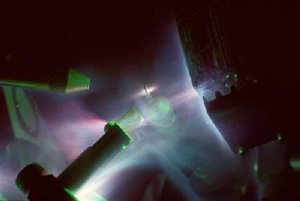 This is an image of the infrared laser (not seen, entering from left-hand side) interacting with a flat target (center), and the associated plasma production from the interaction on the various diagnostic instruments in the chamber. This is a time integrated image over five seconds. Credit: Joe Cowan and Kirk Flippo, LANL
Experiments by Sandrine Gaillard, performed as part of her doctoral thesis which is supervised by Prof. Cowan, director of the Institute of Radiation Physics at the Forschungszentrum Dresden-Rossendorf (FZD), achieved world-record energies for laser accelerated particles. These record results were obtained in partnership with scientists at FZD, Sandia National Laboratories, the University of Nevada, Reno, and the University of Missouri, Columbia, all working at the Trident Laser Facility at the Los Alamos National Laboratory in New Mexico. Protons were accelerated to velocities of 254 million miles per hour (or 37% of the speed of light).
The new record was achieved using specially shaped targets at Trident, the world's highest contrast high-intensity, high-energy laser. The scientists shot high-contrast ultrashort laser pulses lasting approximately 600 femtoseconds (600 quadrillionths of a second) and around 80 Joules directly into the cone-shaped structures, whose flat-top tips are covered with a thin film. The surfaces were created using nanotechnology, and produced by the company Nanolabz.
When the intense laser light collides with the inside of these anvil-like microstructures, electrons are liberated from the material. In contrast to flat-foils, the microstructures act as an electron guide to the tip. The electric field generated can then be used to accelerate the protons to energies that were previously unachievable. X-ray imaging (see Fig. 2) was used as a diagnostic tool to help illustrate and clarify the laser-cone interaction. The precise interactions, however, must still be resolved by the scientists via computer simulations. Next, they will study the cones ability to efficiently convert laser light into high energy protons.
The record measurements will be presented at the annual APS Division of Plasma Physics meeting in November 2009 in Atlanta, GA.