Nov 10 2009
The latest spin-off of Helmholtz Zentrum München is Photonion GmbH. The start-up company was founded as a joint venture with two mid-sized companies, Airsense Analytics GmbH, Schwerin and Tofwerk AG, Thun, Switzerland. Ascenion GmbH also holds equity in the company. The goal of Photonion is to develop new analytical devices based on the mass spectroscopic method invented at Helmholtz Zentrum München in order to be able to directly analyze complex organic gases, liquids or solid materials. Potential applications include process control at a coffee roasting plant or in plastics production, the analysis of cigarette smoke or crude oil, and the detection and determination of fine dust contamination.
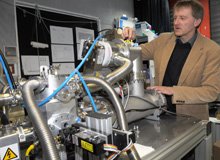 Prof. Ralf Zimmermann (photos: Ulla Baumgart).
The underlying technology is based on one-photon ionization. It utilizes an innovative vacuum ultraviolet light source which was developed by Professor Ralf Zimmermann and his team. “The decisive advantage of photon ionization is that the substance to be measured is hardly disturbed, so that the results are meaningful even for complex mixtures,” Professor Zimmermann said. “Thus we can usually skip the separation processes that are otherwise required in mass spectroscopic analysis and are so expensive and time-consuming. That is why the system is ideally suited for process monitoring and quality control.” Over the long term the company plans to independently develop and market its devices, which will be based on this new technology and will be utilizable in many different applications.
Commenting on the spin-off, Prof. Dr. Günther Wess, president and CEO of Helmholtz Zentrum München, said: “This is yet another success story demonstrating how economic and social value creation can evolve out of public research funding.” He added, “Our model for technology transfer works: Products with a direct benefit for society originate from cutting-edge basic research at Helmholtz Zentrum München.”
Photonion has already entered into two strategic alliances for the development and marketing of two specific analysis systems. One shall enable a direct analysis of organic solids through the combination of thermal analysis and mass spectroscopy. The other can analyze cigarette smoke – directly during smoking. “In many respects, Photonion is an exemplary spin-off project,” said Dr. Christian Stein, managing director of Ascenion. “The management is experienced and is well networked in the sector, the founders’ competences complement each other ideally, and the strategic partnerships will facilitate a fast market entry. In this way the founders can develop their company in a sustainable fashion – without first having to take on large sums of risk capital.”
Tofwerk brings an outstanding infrastructure and a great deal of know-how on the production of mass spectrometric devices to the new enterprise; Airsense has special expertise and experience in systems integration and marketing. In the first phase, the managing directors of Airsense, Dr. Andreas Walte and Wolf Münchmeyer, will head Photonion. Professor Zimmermann will advise the company as consultant and ensure that Photonion has long-term access to the latest research findings. All patents on photon ionization and mass spectroscopy were exclusively licensed to Photonion by Helmholtz Zentrum München. The license agreement was mediated by Ascenion GmbH, which also advised the founding team on legal, strategic and financial issues. The start-up funding is being provided by Helmholtz Enterprise Funds, Helmholtz Zentrum München, Tofwerk and Airsense.
“Due to the close cooperation between scientists, industry and technology transfer,” Professor Zimmermann explained, “we will now be able to harvest the fruits of more than 20 years of research in this field. I am extremely pleased that our invention is now finding application. Moreover, Photonion offers exciting career opportunities for the scientists that began as doctoral students in my team.” Within the framework of the Mass Spectroscopy Center, a cooperative project of Helmholtz Zentrum München and the University of Rostock, Ralf Zimmermann and his colleagues plan to continue their research in the field of photon ionization and to further investigate potential applications, especially in the fields of medicine and energy.