Oct 28 2008
Measuring an electrical current in an organism is pretty straightforward. All you need is an electrode. Measuring the flow of chemicals in cells or live tissue, however, is much more difficult because the molecules diffuse, mix with one another, and interact with their surroundings.
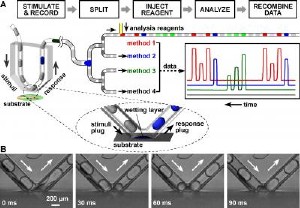 The device is used by being brought into contact with the surface of a cell or tissue under investigation. An array of tiny droplets containing chemical stimuli is then delivered to the sample; chemical reactions occur or molecules are released from the sample, as in the case of a hormone; and the resultant chemical-laden droplets are carried away. All the while, the fluorocarbon carrier fluid remains in contact with the droplets and shields them from the wall of the device. Credit: Ismagilov Lab/University of Chicago
So to help understand biological processes, university researchers have invented a new device, the "chemistrode," that makes it possible to stimulate, record, and analyze molecular signals at high resolution—in terms of precisely when, where, and in what sequence the signals occurred.
The chemistrode will help researchers study any surface that responds to chemical stimulation, including cells, tissue, biofilms and catalytic surfaces. It may also help neurologists, cardiologists, and endocrinologists study and diagnose diseases, according to those who developed the device in the Ismagilov Lab in the Department of Chemistry at the University of Chicago. Researchers in the Lab have already used it to measure how a single murine islet responds to glucose.
The developers have begun to apply for a patent on the new device, and their research describing it will be published online Oct. 27, 2008, by the Proceedings of the National Academy of Science. (The paper will appear in the print version of the prestigious journal on Nov. 4, 2008.)
"An analogue of the electrode, the chemistrode is a droplet-base microfluidic device that will provide exciting opportunities to study stimulus-response dynamics in chemistry and biology," said Rustem Ismagilov, Associate Professor in Chemistry, who conceived the device, coined its name, and heads up the team that developed it.
Previous techniques for stimulating and measuring chemical reactions in organisms relied on laminar flow, which allows the chemicals in question to intermingle and disperse, making them hard to control and measure. The new V-shaped device, on the other hand, traps the chemicals in water droplets and suspends the droplets in a fluorocarbon carrier fluid. This keeps the chemical-laden droplets intact, allowing a controlled stream of stimulating chemicals to enter on one end of the device and a steady stream of distinct resultant chemicals to be captured on the other end. The chemical-laden droplets can be analyzed immediately or stored for future analysis. Furthermore, the droplets can be split up for parallel study by different techniques.
"The inspiration for this work was the microelectrode, but the key to its success was encapsulating the chemicals in aqueus droplets so that the chemicals could be delivered to and picked up from the reactive site in a controllable, measurable fashion," said Delai Chen, a graduate student in the Department of Chemistry and Institute for Biophysical Dynamics at the University of Chicago. Chen was one of the four lead authors of the PNAS research paper, along with University post-doctoral researchers Wenbin Du and Ying Liu, and graduate student Weishan Liu.
A year and one-half in the making, the chemistrode is compatible with traditional methods of culturing cells and tissues because—like the electrode—it can be used on any surface. The device is used by being brought into contact with the surface of a cell or tissue under investigation. An array of tiny droplets containing chemical stimuli is then delivered to the sample; chemical reactions occur or molecules are released from the sample, as in the case of a hormone; and the resultant chemical-laden droplets are carried away. All the while, the fluorocarbon carrier fluid remains in contact with the droplets and shields them from the wall of the device.
"The chemistrode offers a time-resolved, high-fidelity record of molecular stimulation and response dynamics," Ismagilov said. "Our PNAS paper describes the physical principles that guide the operation of the chemistrode. It also implements the chemistrode to test the feasibility of each step and the compatibility of this platform with living cells."
For now, the device "allows you to look very hard and precisely at living cells in a dish, but it has the potential to be used in whole organisms, as well," said Louis Philipson, a professor in the Department of Medicine and co-author on the paper. "The chemistrode offers real-time input-output analysis captured in excellent resolution. As such, it will facilitate research in a lot of areas and holds the potential for widespread applications in medicine.
"The development of this device is a wonderful example of the lack of walls at the University of Chicago," Philipson added. "Here, physicians can interact with other scientists in unconventional ways and bring together different kinds of technology. The result is new ways of looking at things and new answers to old problems."