Oct 30 2008
Researchers in China are reporting development of a new DNA "tweezers" that are the first of their kind capable of grasping and releasing objects on-demand. The microscopic tweezers could have several potential uses, the researchers note. Those include microsurgery, drug and gene delivery for gene therapy, and in the manufacturing of nano-sized circuits for futuristic electronics. Their study is scheduled for the November 12 issue of the weekly Journal of the American Chemical Society.
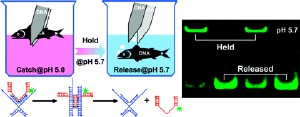 A pair of DNA tweezers are constructed, which are capable of capturing, holding and releasing a DNA object by playing with the open and close actions of the tweezers assisted by pH switchings. The object is captured between the tweezers’ arms at pH 5.0 through Hoogsteen hydrogen bonding and can be stably held even when the pH is increased to 5.7 after the tweezers are closed. Upon introducing a DNA unlocker strand, the tweezers are opened and the object gets released. This capture-hold-release process can be easily cycled without losing much of its efficiency.
Zhaoxiang Deng and colleagues note that other scientists have developed tweezers made of DNA, the double helix molecule and chemical blueprint of life. Those tweezers can open and close by responding to complementary chemical components found in DNA’s backbone. However, getting the tweezers to grasp and release objects like real tweezers has remained a bioengineering challenge until now.
The scientists describe development of a pair of DNA tweezers composed of four DNA strands — three which act as the “arms.” In laboratory studies, the scientists showed that they could grab a piece of target DNA in the arms of the tweezers and release it on-demand using a controlled series of hydrogen bonding and pH changes. The scientists used fluorescent gel imaging to confirm the effectiveness of the tweezers’ operation. — MTS