Jan 11 2009
Scientists at U.S. Department of Energy's Argonne National Laboratory used inelastic neutron scattering to show that superconductivity in a new family of iron arsenide superconductors cannot be explained by conventional theories.
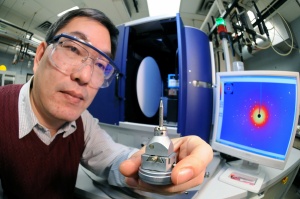 Materials engineer Duck Young Chung examines a sample of superconducting crystals before characterizing them in a X-ray diffractometer. The crystals signify the next generation of experiments utilizing neutron scattering to determine unconventional superconductivity.
"The normal techniques for revealing unconventional superconductivity don't work with these compounds," physicist Ray Osborn said. "Inelastic neutron scattering is so far the only technique that does."
Conventional superconductivity can be explained by a theory developed by Bardeen, Cooper and Schrieffer (BCS) in 1957. In BCS theory, electrons in a superconductor combine to form pairs, called Cooper pairs, which are able to move through the crystal lattice without resistance when an electric voltage is applied. Even when the voltage is removed, the current continues to flow indefinitely, the most remarkable property of superconductivity, and one that explains the keen interest in their technological potential.
Normally, electrons repel each other because of their similar charge, but, in superconductors, they coordinate with vibrations of the crystal lattice to overcome this repulsion. But scientists don't believe the vibrational mechanism in the iron arsenides is strong enough to make them superconducting. This has led theorists to propose that this superconductivity has an unconventional mechanism, perhaps like high-temperature copper-oxide superconductors. Some iron arsenides are antiferromagnetic, rather than superconducting, so magnetism rather than atomic vibrations might provide the electron glue.
In BCS superconductors, the energy gap between the superconducting and normal electronic states is constant, but in unconventional superconductors the gap varies with the direction the electrons are moving. In some directions, the gap may be zero. The puzzle is that the gap does not seem to vary with direction in the iron arsenides. Theorists have argued that, while the size of the gap shows no directional dependence in these new compounds, the sign of the gap is opposite for different electronic states. The standard techniques to measure the gap, such as photoemission, are not sensitive to this change in sign.
But inelastic neutron scattering is sensitive. Osborn, along with Argonne physicist Stephan Rosenkranz, led an international collaboration to perform neutron experiments using samples of the new compounds made in Argonne's Materials Science Division, and discovered a magnetic excitation in the superconducting state that can only exist if the energy gap changes sign from one electron orbital to another.
"Our results suggest that the mechanism that makes electrons pair together could be provided by antiferromagnetic fluctuations rather than lattice vibrations," Rosenkranz said. "It certainly gives direct evidence that the superconductivity is unconventional."
Inelastic neutron scattering continues to be an important tool in identifying unconventional superconductivity, not only in the iron arsenides, but also in new families of superconductors that may be discovered in the future.
A paper ("Unconventional superconductivity in Ba0.6K0.4Fe2As2 from inelastic neutron scattering") on Osborn's and Rosenkranz's work has been published in volume 456, pages 930-932, of Nature. Funding for this research was provided by the U.S. Department of Energy, Office of Science, Office of Basic Energy Sciences.