With a $3.2 million grant from the National Science Foundation, biologists and engineers at UC Berkeley will be stepping up their collaborative effort to learn from nature and apply their discoveries for the benefit of humanity. The five-year grant to Berkeley's Center for interdisciplinary Biological-inspiration in Education and Research (CiBER) will support development of an interdisciplinary doctoral program aimed at translating biological discoveries into engineered devices, and, conversely, applying new engineering approaches to generate hypotheses and tools for biological research. The grant comes through NSF's Integrative Graduate Education and Research Traineeship (IGERT) program.
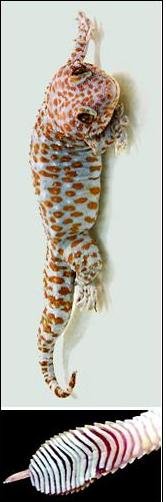 Tokay gecko climbing a wall (top); close-up of gecko toe, which adheres to surfaces using millions of tiny hairs (bottom). (Credits: Pauline Jennings, Kellar Autumn)
The funding will provide 25 biology and engineering PhD students with two-year fellowships early in their studies. Working in interdisciplinary teams, the fellows will focus on how motion systems — from molecular motors in cells to ways of swimming through turblent oceans — work in and adapt to diverse environments. A better understanding of biological motion will be useful for designing human-engineered systems that must move in the real world, says Professor of Integrative Biology Robert Full, principal investigator for the grant and director of CiBER.
From super adhesives to search-and-rescue robots
Sam Burden, an electrical engineering and computer sciences PhD student, says the interdisciplinary grant "speaks to" his hope to see biologists and engineers work together to make discoveries relevant to both fields. Burden came to Berkeley specifically to study the mathematics of robotics as informed by biology. Many man-made robots, he notes, still have trouble remaining upright on uneven terrain or when faced with external obstacles; to improve their design, he says, engineers need to look to nature.
In Full's animal-locomotion lab, Burden and other researchers have been studying a locomotion star — a cockroach that can transition, at full throttle, from running on rough terrain to climbing a vertical wall — trying to understand what keeps it from flipping over. Whether it's a "thinking" process or "passive mechanical or reflexive properties of its body," Burden says, "if we understand those principles in the animal, we can apply those to a robot." Within 15 years, he expects to see stable, cockroach-sized robots that can be deployed, following an earthquake, to scramble into the rubble to locate natural gas leaks and people who are trapped.
Another example of bio-inspired design began with the study of gecko feet. Full was curious about geckos' ability to run up a wall at a meter per second and adhere to virtually any kind of surface. By studying the biomechanics of these remarkable lizards, he discovered that their toes are covered with millions of tiny hairs, each with a thousand nano-sized split-ends.
Full and his biology colleagues teamed with engineering professor Ron Fearing, an IGERT co-PI. Together they discovered that the gecko's locomotive and adhesive genius depends only on intermolecular interactions — not glue, suction, or Velcro-like interlocking. Fearing used this insight to make a synthetic, gecko-inspired, self-cleaning adhesive that promises to have a diversity of practical applications. Other IGERT projects include exoskeletal assist suits informed by muscles and bone; orthopedic biomaterials; brain-machine interfaces; novel sensors based on lobster antennae; insect-inspired search-and-rescue robots that can run, glide, and fly; and artificial compound eyes, also based on insects.
A core curriculum and foreign research opportunities
With the NSF funding, a customized core curriculum will help biology and engineering graduate students develop a common scientific language, then work in teams in a new teaching lab to make original biomechanical discoveries. Fellows will select research rotations from among 32 faculty in seven campus departments — integrative biology, molecular and cell biology, bioengineering, electrical engineering and computer science, mechanical engineering, civil engineering, and psychology.
The grant also includes $200,000 to allow CiBER-IGERT fellows to conduct research at leading international research centers, located at institutions such as the Ecole Polytechnique Fédérale de Lausanne, the Swiss Federal Institute in Zurich, and the University of Zurich. Fellows can also work at one of the 70 universities, institutes, and research facilities involved in Germany's Bionics Competence Network.
Biosciences Dean Mark Schlissel notes that the new training grant promises to "help propel the Berkeley campus to the leading edge of this new and exciting multidisciplinary area of biologically-inspired engineering research." Collaborative interactions it promotes will lead to important new discoveries, he predicts.