Oct 29 2009
Steven Pieper and Robert Wiringa, senior scientists at the U.S. Department of Energy’s (DOE) Argonne National Laboratory, have won the 2010 Tom W. Bonner Prize in nuclear physics. The award will be presented by the American Physical Society in Washington, D.C., in February 2010.
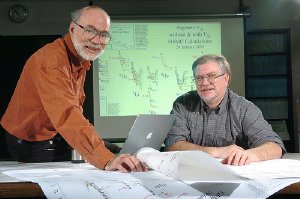 Steven Pieper (left) and Robert Wiringa, senior scientists at Argonne National Lab, have won the 2010 Tom W. Bonner Prize in nuclear physics.
Pieper and Wiringa, who are theoretical physicists, won the prize for developing and applying models of nuclear forces and methods to calculate the properties of light nuclei. The prize typically recognizes outstanding experimental research in nuclear physics, but in special circumstances it may be awarded for outstanding theoretical work.
“We are deeply honored to be chosen for the Bonner Prize,” Wiringa said. “It has been our life’s work to develop a better understanding of nuclear forces and nuclei.”
Pieper and Wiringa have been pioneers in developing models of these forces. Wiringa and his collaborators at Jefferson Lab and elsewhere developed the Argonne v18 potential, a model of nucleon-nucleon interactions that has become a de facto standard in the nuclear structure community. The ability to conduct computations of ever larger nuclei required advances in computers and the algorithms used—issues that Pieper has been addressing over the past dozen years with a state-of-the-art quantum Monte Carlo program. This program enabled Pieper and Wiringa, together with collaborators from the University of Illinois at Urbana-Champaign and Los Alamos National Laboratory, to develop several models of three-nucleon forces.
“Interactions between nucleons are much more complicated than the interactions between the electrons and nucleus in an atom,” Wiringa said. “The interactions depend not only on the separation of the nucleons but on how their spins and isospins combine, and on the orientation of their spins.” As a result, calculations of even small nuclei are extremely difficult.
Recently, in collaboration with researchers in Argonne’s Mathematics and Computer Science Division, Pieper has enhanced the quantum Monte Carlo program to model nuclear states up to carbon-12. This work, funded by a DOE Scientific Discovery through Advanced Computing (SciDAC) grant, resulted in a novel subroutine library for using massive parallel computers. Key to this effort has been access to the IBM Blue Gene/P supercomputer in the Argonne Leadership Computing Facility.
“We have been able to use more than 133,000 processors of the Blue Gene/P for these complex calculations,” Pieper said. He and his colleagues receive large amounts of computer time on the Blue Gene/P through a special grant from the DOE Innovative and Novel Computational Impact on Theory and Experiment (INCITE) program.
Pieper has been with Argonne since 1972 and Wiringa since 1981. Both researchers received a doctoral degree from the University of Illinois at Urbana-Champaign. Both are Fellows of the American Physical Society, and they shared the 2000 University of Chicago medal for Distinguished Performance at Argonne.
In addition to Pieper and Wiringa, three other Argonne physicists have won the Bonner Prize – Roy Holt in 2005, Lowell Bollinger in 1986, and John Schiffer in 1976.