Free-electron-laser light sources, such as the Linac Coherent Light Source (LCLS) at the SLAC National Accelerator Laboratory, arrived on the scene promising a unique scientific capability: "single-shot imaging." The idea is that a single, short-enough pulse of bright x-rays can generate enough information about a sample, perhaps a virus or a strand of DNA, to record the position of all its atoms before the energetic pulse blows the sample apart.
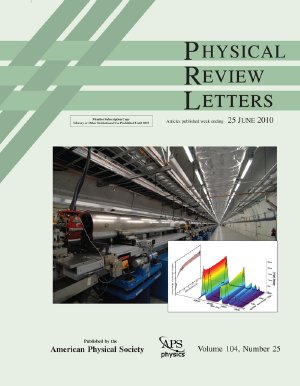 The first scientific publication from the Linac Coherent Light Source, which appears on the cover of the June 25, 2010 issue of Physical Review Letters, reveals a mechanism called "frustrated absorption" that explains why ultrashort pulses of x-rays, even though they pack high peak power, do less damage to molecules.
"This is a new kind of light, which mankind has never seen before," says Oliver Gessner of Berkeley Lab's Ultrafast X-ray Science Laboratory in the Chemical Sciences Division (CSD). "Until now, no one has ever tested what ultrashort pulses of ultra-intense x-rays, delivering an enormous amount of power in a very short time, actually do to molecules. Can molecules really be imaged in a single shot, or will radiation damage them or destroy them too quickly?"
Gessner led the Berkeley Lab contingent of a multinational collaboration that used the LCLS's Atomic, Molecular and Optical Science instrument to study what effects femtosecond x-ray pulses (a femtosecond is 10-15 seconds, a quadrillionth of a second) had on a simple molecular system, nitrogen. Gessner and his CSD colleagues Oleg Kornilov and Stephen Leone, working with Stephen Pratt of Argonne National Laboratory and other key members of the team, performed the critical analysis and interpretation of the data and modeled the physics of what turned out to be quite a surprising experiment.
The experiment called for blasting nitrogen molecules with pulses ranging from 280 to only four femtoseconds in duration. Since each pulse packed the same number of photons (particles of light), the peak power increased as the pulses grew shorter. Nevertheless, the shortest pulses did the least damage.
Nora Berrah and Matthias Hoener of Western Michigan University, guests at Berkeley Lab's Advanced Light Source, were respectively the principal investigator and the first author of the paper reporting the results, which appeared in the 25 June 2010 issue of Physical Review Letters and is available online to subscribers.
Taking nitrogen apart
Each of a nitrogen molecule's two atoms has seven electrons. At the LCLS the research team worked with 1.1-nanometer wavelength x-rays (a nanometer is a billionth of a meter), whose photons interact almost exclusively with an atom's core electrons, those in orbitals nearest the nucleus. When a photon knocks an inner electron out of an atom, one of the outer electrons quickly falls into the hole, in a process called Auger decay that provides enough energy for a third electron to be ejected from the atom. This leaves the atom "doubly ionized" – short a total of two electrons, thus having +2 positive charge.
If more photons in the same x-ray pulse hit the same atom, core electrons can be ejected over and over again, each ionization event being followed by Auger decay – or, in the case of extremely bright pulses, even creating double core holes in a nitrogen molecule, with both in the same atom or one hole in each.
It was no surprise to the researchers that a "long" pulse of high-energy x-rays (280 quadrillonths of a second long!), hitting the atom with one photon after another, could strip an atom of all seven of its electrons, reducing it to a bare core of +7 positive charge.
High-charge-state ions in a molecule cause strong Coulomb forces, repulsive forces that try to blow its atoms apart. But the research team's crucial finding was that a way to produce only lower charge states in nitrogen molecules is with shorter pulse lengths, even though their peak power is higher.
When pulses are seven femtoseconds or less in duration, their photons are moving through the atom so close together that Auger decay often can't fill up core holes fast enough for photons later in the pulse to photoionize them again. Unfilled holes mean fewer inner electron targets. The number of higher charge states falls off sharply.
The researchers named this phenomenon "frustrated absorption," a molecular mechanism that protects the integrity of molecules by preventing their constituent atoms from being stripped of the outermost valence electrons that hold them together.
"Molecules aren't just atoms stuck together," Gessner remarks. "To understand how molecules are damaged, you have to study the molecules themselves. Although the molecular system we studied is very simple, our result is a start at describing the quantitative damage an illuminating pulse is liable to do to your target."
From these observations, the research team constructed a model that may allow future researchers at the LCLS and similar facilities to calculate what kind of image distortion to expect from pulses of different lengths. The bottom line would appear to be: the shorter the pulse the less the damage.