Oct 29 2010
The Department of Biomedical Engineering, Johns Hopkins University School of Medicine is using the NanoSight LM10-HS system to study self-assembled polymer/DNA particles for drug delivery.
The main research interests of Dr Jordan Green of the Biomaterials and Drug Delivery Laboratory are in cellular engineering and nanobiotechnology. Knowledge of particle size is of particular value in the characterization of different drug delivery systems. Having had previous experience using dynamic light scattering techniques, Dr Green and his team now also use the complementary technique of nanoparticle tracking analysis from NanoSight. NTA provides insight into their samples particularly those with polydisperse behavior.
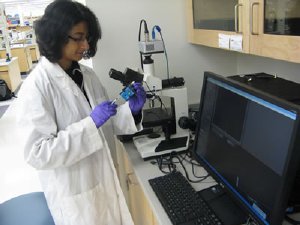 Nupura Bhise of the Jordan group at JHU using the NanoSight LM10
Nupura Bhise of the Jordan group at JHU using the NanoSight LM10
Nupura Bhise of the Jordan group at JHU using the NanoSight LM10
The laboratory chose the NanoSight LM10-HS system equipped with an EMCCD high sensitivity camera and a 404 nm laser for particle sizing analysis. In a typical study, particle solutions were diluted in DI water to adjust the sample concentration to a level such that there were approximately 30-60 light scattering centers in the visual analysis window. A sixty second movie containing the Brownian motion tracking of each individual particle was recorded. The movie was processed to enable detection of a least 250 particle tracks per sample. The NTA analysis gives a direct number-averaged distribution of the particle size as well as absolute particle concentration. The mean, standard deviation and mode of the particles is then calculated.
In this method, each individual particle is independently sized so that a direct number-averaged mean can be calculated. As each particle is counted, a mode, or the peak in the number distribution, can also be calculated. For monodisperse particle populations, both DLS and NTA measured the same values for particle size. However, NTA allowed finer distinction between peaks in samples that were polydisperse. The uniformity of polymeric nanoparticle distribution is thought to be a property of the polymer structure, and in particular, of the polymer terminal group. Changes to polymer terminal group were also found to dramatically change gene delivery efficacy of these nanoparticles in 2-D and 3-D cell systems.
Dr Green said that “To our knowledge, this is the first time that NTA has been used for self-assembled polymer/DNA particles. Our results highlight its utility, especially when combined with traditional DLS analysis.”