Oak Ridge National Laboratory researchers Jeremy Busby, De-en Jiang and Sergei Kalinin are among 13 Department of Energy scientists to receive the Presidential Early Career Award for Scientists and Engineers, or PECASE. The PECASE, one of the nation's top honors for young scientists, was designed to recognize some of the finest researchers who show exceptional potential for leadership at the frontiers of scientific knowledge.
"Science and technology have long been at the core of America's economic strength and global leadership," President Obama said. "I am confident that these individuals who have shown such tremendous promise so early in their careers will go on to make breakthroughs and discoveries that will continue to move our nation forward in the years ahead."
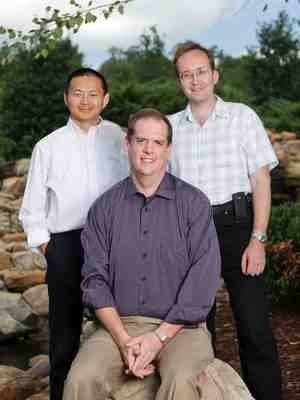 (From left) De-en Jiang, Jeremy Busby and Sergei Kalinin are among 13 Department of Energy researchers to receive the Presidential Early Career Award for Scientists and Engineers.
The three winners will receive DOE funding for up to five years to advance their research. The awardees, which are for the year 2009, will be recognized in a White House ceremony.
"These gifted young scientists and engineers represent the best in our country," Energy Secretary Steven Chu said. "The awards recognize ingenuity, dedication, diligence and talent. I congratulate the 2009 PECASE awardees and wish them continued success toward new discoveries and advances in science, energy research and national security."
Since the award's inception in 1996, ORNL researchers have received 18 of the White House honors. ORNL Director Thom Mason said this year's winners demonstrate the lab's continued commitment to attracting and retaining young scientific talent.
"These awards recognize the outstanding creativity that early career researchers bring to the community of science at ORNL," Mason said.
Busby, a member of ORNL's Materials Science & Technology Division, focuses his research on structural materials for nuclear reactors, including the testing and development of advanced reactor materials. His research contributions have been both substantial and diverse, ranging from support for light-water reactors to space reactor systems as well as research for the ITER fusion project.
For example, Busby helped develop a new cast stainless steel that is 70 percent stronger than comparable steels, for possible use in the ITER fusion reactor. Busby, a resident of Knoxville, holds a doctorate in nuclear engineering from the University of Michigan.
Jiang was recognized for his internationally acknowledged and pioneering computational research, which involves probing novel properties of nanostructures and chemically modified interfaces. Since joining ORNL's Chemical Sciences Division in 2006, his versatile applications of computational methods have been applied to understand and solve chemical problems in materials such as thiolated gold nanoclusters and graphene. Jiang, a resident of Knoxville, received his doctorate in chemistry from the University of California, Los Angeles.
Kalinin's research at ORNL's Center for Nanophase Materials Sciences is centered on advanced scanning probe microscopy methods and applications. His innovative work has introduced several novel analytical and experimental advances in scanning probe microscopy that expand the range of physical phenomena that can be explored with nanoscale precision, including polarization dynamics, ionic motion, electronic transport and energy dissipation.
By developing and applying novel microscopy techniques, Kalinin has gained insight into mechanisms of bias-induced phase transitions on the single defect level in ferroelectrics and multiferroics, and on electrochemical reactions at the nanoscale for energy storage and conversion materials. Kalinin, who resides in Knoxville, has a doctorate in materials science and engineering from the University of Pennsylvania.
Another PECASE recipient, Rahul Ramachandran, was recognized as a NASA awardee. Ramachandran recently came to ORNL from the University of Alabama at Huntsville and is now working in ORNL's Computational Sciences and Engineering Division.