For a scientist who studies the paths traveled by neutrinos, Mayly Sanchez has blazed a bright one of her own. Sanchez, a particle physicist at the U.S. Department of Energy's (DOE) Argonne National Laboratory, received an Outstanding Technical Achievement Award from the Hispanic Engineer National Achievement Award Corporation, or HENAAC.
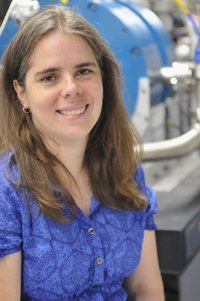 Mayly Sanchez, an Argonne particle physicist, received an Outstanding Technical Achievement Award from HENAAC, the Hispanic Engineer National Achievement Award Corporation.
Sanchez, who was born in Venezuela and has worked at Argonne since 2007, received the honor for her work in high-energy physics. The Outstanding Technical Achievement award is presented to a scientist who has made "significant contributions to science, engineering or technology." Sanchez heads a team that searches for the traces left behind by neutrinos, one of the elementary particles of the universe, as they change form.
Physicists know that neutrinos come in three different types, or "flavors": electron, muon and tau. Although a neutrino's flavor can change during its lifetime, researchers have never caught one in the act. "We see them disappear, and we can see signatures of missing neutrinos," Sanchez said. "Now we're looking for the neutrinos that reappear."
Sanchez's experiment capitalizes on the fact that neutrinos can pass through solid matter undisturbed—in fact, millions pass through the human body every second. Fermilab, a high-energy physics laboratory located in Batavia, Ill., beams a ray of neutrinos through the Earth. Almost 500 miles away, an underground physics chamber located in an old iron mine beneath Minnesota's Iron Range mountains detects the neutrinos.
Sanchez and her team hope to find the trace of a particle that changed from a muon type to electron type along its journey. "Neutrinos are more likely to change type the farther they travel," Sanchez explained.
Unfortunately, even over 450 miles, the events remain extremely rare. In the two years of data, Sanchez and her team have found fewer than 10 likely instances of suspected transformations.
For Sanchez, the tiny particles could help scientists understand one of the biggest problems in contemporary physics. "What is matter really made of? I love that question," Sanchez said.
Sanchez developed her interest in physics early on, when a friend brought a copy of Carl Sagan's Cosmos to school. "Then I asked for the book for my birthday," Sanchez said. "My parents must have thought that was so weird—a 14-year-old asking for an astronomy book." Her fascination with the universe only deepened, though, and it propelled her into physics classes in college.
"That's what I like about this award—it's an award with a message," Sanchez said. "I want kids in high school, especially girls, to think about it. Stick with your math and physics classes—if you like it, you should pursue it, because it's a great career. You get to work with people all over the world."
HENAAC considers candidates as role models to the Hispanic community, in addition to evaluating the significance of their scientific work.
HENAAC is an educational non-for-profit program, which runs programs designed to introduce students from kindergarten to college-age to careers in science and technology. The program also awards scholarships and travel grants to college students across the country. The award was presented at HENAAC's annual National Career Conference and Awards Show, held October 8-10, 2009 in Long Beach, Calif.
Sanchez is the eighth Argonne scientist to receive a HENAAC award since 1998. Most recently, Monica Regalbuto, head of Argonne's Process Chemistry and Engineering Department, and Juan Carlos Campuzano, Argonne Distinguished Fellow, both received awards in 2007.