JPK Instruments, a world-leading manufacturer of nanoanalytic instrumentation for research in life sciences and soft matter, is happy to announce the latest member of their nanotechnology characterization systems family: the ForceRobot300, the new standard in single molecule force spectroscopy.
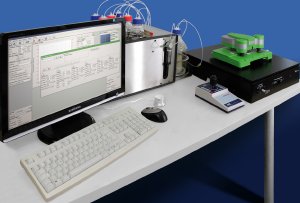 The JPK Force Robot®300 system
Force spectroscopy is a single molecule technique that allows the real-time study of molecular interactions on the nanoscale. Originating from the broad field of Atomic Force Microscopy (AFM), force spectroscopy directly addresses the measurement of forces between and within molecules. The sensitivity is high enough to characterize molecular interactions such as the unfolding forces of single proteins or forces of a single molecular bond.
The key to obtaining meaningful results from single molecule techniques such as force spectroscopy is the statistical management of the results. This is where the new ForceRobot300 technology delivers the solution. The automated setup and continuous adjustments provide improvements in the efficiency of data collection while the integration of optical techniques allows targeted measurements where the molecules of interest are located. These factors, combined with the highest data quality and stability, open the field of single molecule force spectroscopy to a new level of results.
Until now, single molecule force spectroscopy was a complicated procedure. The requirement of frequent manual calibrations and alignments as well as the need for constant operator presence with the instrument made it a long-winded task. Useful data output was both low and slow with only a few suitable curves obtained over many hours. The ForceRobot300 addresses these issues as a dedicated tool for the force spectroscopist.
The key to the system is the incorporation of intelligent software for experimental design, data acquisition and evaluation. Tens of thousands of force curves may be generated and evaluated in a matter of hours. To produce high quality curves requires an exceptional instrument with the lowest noise floor and the most rigid mechanical design. The highest accuracy and stability of the instrument is ensured by integrated capacitive position sensors with drift being minimized thorough utilizing a symmetrical system design.
The system may be operated in a stand-alone mode (see photograph) to give maximum access and flexibility to the sample. Alternatively, it may be mounted on top of an inverted optical microscope to enable simultaneous force spectroscopy and fluorescence microscopy. Both versions are available with a choice of positioning stage. While the basic motorized stage will provide positioning to better than one micron, the Precision Mapping Stage uses closed-loop control with noise levels to better than 0.3nm with positioning to about 1nm.
Like all JPK's advanced instruments, the ForceRobot300 has many further options for fluidics and temperature control to enable the most reproducible results. To learn more, visit the product page to download a brochure and read about various applications.