Five researchers at the U.S. Department of Energy's Argonne National Laboratory will lead projects that have been awarded a total of 80 million hours of computing time on Argonne's energy-efficient Blue Gene/P. Using the computer allotments, the researchers will conduct advanced simulation and analysis and will develop scalable system software needed to fully utilize the power of leadership-class computing facilities.
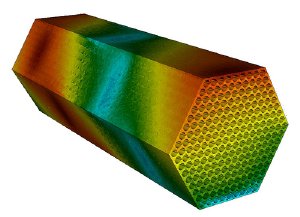 Coolant-flow pressure distribution in a 217-pin wire-wrapped subassembly, computed on the Argonne Leadership Computing Facility's Blue Gene/P supercomputer. Image by members of the Argonne SHARP project, Paul Fischer, Aleks Obabko, Andrew Siegel, Dave Pointer and Jeff Smith.
The projects, selected competitively based on their potential to advance scientific discovery, were awarded the supercomputer time through the U.S. Department of Energy (DOE) Innovative and Novel Computational Impact on Theory and Experiment (INCITE) program. Four of the projects are new, and one is a renewal.
Paul Fischer, a senior computational scientist, was awarded 30 million hours on Argonne's Blue Gene/P as well as additional time at Oak Ridge National Laboratory to conduct simulation and analysis of fast neutron reactors. Fischer and his colleagues will study open questions concerning the thermal-hydraulic performance – that is, the pressure drop and mixing induced by the coolant flow – in these next-generation reactors. Thermal-hydraulic performance issues figure prominently in understanding how to design a “closed” nuclear fuel cycle that reduces the burden of geological disposal of nuclear spent fuel. “Advanced simulation is viewed as critical in bringing fast reactor technology to fruition in an economic and timely manner,” said Fischer.
Andrew Binkowski, a structural biologist, will lead an Argonne team in a study of protein-ligand binding interactions. Binkowski and his team will use the 25 million hours of computer time awarded on the Blue Gene/P to apply the most advanced methods in biomolecular simulations and analysis to further understanding of human health and disease. “A major obstacle to accurate biomolecular modeling is the number of approximations necessary to reduce the complexity of the system. Using the BlueGene/P will allow us to relax these constraints and perform calculations in a matter of hours that would previously have taken years,” said Binkowski.
The team will also evaluate and validate the predictive power of bimolecular simulations through collaboration with the Center for Structural Genomics of Infectious Diseases.
Jeff Greeley, a materials scientist, was awarded 10 million hours of supercomputing time on Argonne's Blue Gene/P to investigate materials at the nanoscale. (A nanometer is one billionth of a meter). Greeley will lead a collaboration to understand the electronic and chemical properties of metal particles across the nanoscale regime.
“We expect insights gained from having access to Argonne's supercomputing resources to open significant new opportunities for manipulating and selecting nanoparticles for groundbreaking technological applications,” Greeley said.
Ewing (“Rusty”) Lusk, director of Argonne's Mathematics and Computer Science Division, was awarded 5 million processor hours on the Blue Gene/P to improve the performance and productivity of key system software components. Lusk will head a team investigating message-passing libraries, parallel input/output, data visualization and operating systems on the leadership-class computer systems. “Through rigorous experimentation, analysis and design cycles, we hope to dramatically enhance the capabilities of these systems,” said Lusk.
Andrew Siegel, a computational scientist and leader of Argonne's nuclear simulation activities, was awarded 10 million hours to continue his numerical experiments of “thermal striping” – temperature fluctuations generated by the mixing of flows in sodium-cooled fast reactors. Siegel is collaborating with Argonne's nuclear engineers to study these fluctuations, which can cause components to crack.
“Traditionally, designers have relied on data from instrumented experiments, but this data is expensive and difficult to collect,” said Siegel. “Computation has also been used, but with reduced models that greatly limit predictability. With the INCITE resources, we can carry out the first detailed numerical experiments of thermal striping on realistic reactor geometries.”
The 163,840-processor Blue Gene/P at Argonne has a peak performance of 557 teraflops. “By providing millions of hours of computing time on this powerful system, the DOE INCITE awards allow us to address some of the nation's most challenging scientific problems,” said Rick Stevens, associate laboratory director of Computing, Environment, and Life Sciences at Argonne. “Argonne researchers will be attacking these problems on two major fronts: simulation of advanced technologies and development of the key system software needed to take complete advantage of our nation's powerful leadership-class computers.”
The INCITE program was established by the U.S. Department of Energy Office of Science seven years ago to support computationally intensive, large-scale research projects. INCITE awards sizeable allocations (typically, millions of processor-hours per project) on some of the world's most powerful supercomputers at DOE's Leadership Computing Facilities at Argonne National Laboratory in Illinois and Oak Ridge National Laboratory in Tennessee.