Feb 19 2010
Partnership between specialists in automation can yield important benefits to research and OEM users. With each player bringing specific expertise, teamwork often surpasses what a single organization can achieve.
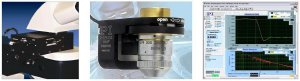 [Left] FocusTrac™: an innovative laser autofocus module of provides speed and compatibility. [Middle] PIFOC®: High-bandwidth, high-precision piezo actuation provides autofocus responsiveness. [Right]: Typical step/settle response, measured interferometrically, for 250µm wafer edge scanned at 12mm/sec with 10X objective.
A case in point: the engineers at Motion X and PI have developed a novel, laser-based system that combines Motion X’s high-bandwidth autofocus sensor with PI’s high-speed piezo driven PIFOC® objective and Z positioners to provide a big step forward in autofocus responsiveness, stability and accuracy. The modular and configurable architecture avoids image degradation and is suitable for commercial and custom microscopes and for substrates ranging from wafers with sensitive coatings to live biological samples.
Background
Achieving and maintaining a sharp focus can be a critical task for systems engineers and researchers. Autofocus is important to users of standard microscopes and designers of custom optical columns alike, and some applications require real-time autofocus during processes in which the substrate is moved. Several approaches have been popular but can present significant drawbacks. Probe-based mechanisms compensate for drift by measuring the position of the sample plate versus the optical column but are slow, cumbersome to set up and limited in effective resolution due to the problematic probe/sample mechanical interface. They also only maintain a mechanical setpoint and cannot correct for variations in sample thickness, drift between the probe and sample, parfocality errors between objectives, drift in the optics or the column itself, and so on. By comparison, optical autofocus techniques have the advantage of evaluating the image via the optics. All mechanical, thermal and optical issues which can impact focus, including changes and steps in the sample itself, are compensated.
The teamwork between PI and Motion X married Motion X’s unique FocusTrac™ system to PI’s proven controls and piezo mechanics for plug-and-play autofocus capability. PI’s PIFOC® piezo objective and Z positioners are typically 10X faster than stepper or servo focusers and can realize the full bandwidth capability of the Motion X laser autofocus technique. Different laser wavelengths are easily accommodated, and mechanical options include objective positioners, turret positioners, sample-positioning and (well-plate) Z-stages and cost-effective OEM Z-positioning elements. FocusTrac™ works with microscopes from industry leaders including Olympus, Leica, Nikon, Zeiss and Mitutoyo and is readily integrated into OEM assemblies as well.
More information: www.pi-usa.us/pdf/Faster_Autofocus_with_Laser_and_Piezo.pdf