Asylum Research, the technology leader in scanning probe/atomic force microscopy (AFM/SPM) announces a new application note by the Ginger group at the University of Washington, focusing on their work on Organic Photovoltaics (OPVs).
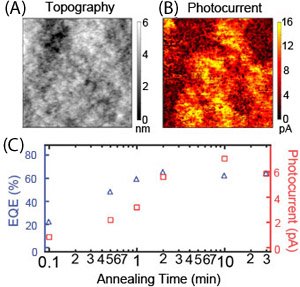 Microscopic heterogeneity in (A) topography and (B) photocurrent on P3HT/PCBM blends. (C) Correlation between spatially-averaged photocurrent measured via photoconductive AFM (pcAFM) and EQE measurements for P3HT/PCBM blends annealed for different lengths of time indicate that pcAFM data are qualitatively consistent with expected device performance.
The application note is entitled “New Scanning Probe Techniques for Analyzing Organic Photovoltaic Materials and Devices,” by Rajiv Giridharagopal, Guozheng Shao, Chris Groves, and David S. Ginger, Department of Chemistry, University of Washington, Seattle. All work for the application note was performed using an MFP-3D-BIO™ Atomic Force Microscope from Asylum Research.
The note reviews the instrumental issues associated with the application of scanning probe microscopy techniques, such as photoconductive atomic force microscopy and time-resolved electrostatic force microscopy, which have been shown to be useful in the study of nanostructured organic solar cells. These techniques offer unique insight into the underlying heterogeneity of OPV devices and provide a nanoscale basis for understanding how morphology directly affects OPV operation and efficiency. The note is available on request from Asylum Research and can also be downloaded at here.
"The customizability of the MFP-3D and Asylum's support were critical to the success of the experiments that got me tenure," said co-author and Group Leader, David Ginger. “This note summarizes the instrumental side of our work to date and, in particular, describes some of the new SPM techniques that have been proven to be very useful in evaluating OPV materials.”