Using a microscope designed to image the arrangement and interactions of electrons in crystals, scientists have captured the first images of electrons that appear to take on extraordinary mass under certain extreme conditions.
The technique reveals the origin of an unusual electronic phase transition in one particular material, and opens the door to further explorations of the properties and functions of so-called heavy fermions. Scientists from the U.S. Department of Energy’s (DOE) Brookhaven National Laboratory, McMaster University, and Los Alamos National Laboratory describe the results in the June 3, 2010, issue of Nature.
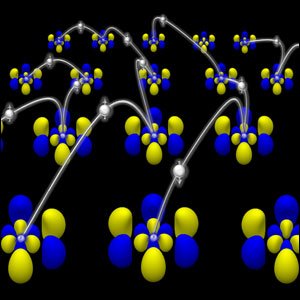 In this schematic diagram, individual electrons (white spheres) interact with uranium atoms (shown as yellow and blue f-electron orbitals of the uranium atoms) as they move through the URu2Si2 crystal. These interactions drastically inhibit the progress of the electrons, making them appear to take on extraordinary mass – an effect imaged for the first time in this study.
“Physicists have been interested in the ‘problem’ of heavy fermions — why these electrons act as if they are hundreds or thousands of times more massive under certain conditions — for thirty or forty years,” said study leader Séamus Davis, a physicist at Brookhaven and the J.D. White Distinguished Professor of Physical Sciences at Cornell University. Understanding heavy fermion behavior could lead to the design of new materials for high-temperature superconductors. Superconductivity allows materials to carry current with no energy loss.
In the current study, the scientists were imaging electronic properties in a material composed of uranium, ruthenium, and silicon that itself has been the subject of a 25-year scientific mystery. In this material — synthesized by Graeme Luke’s group at McMaster — the effects of heavy fermions begin to appear as the material is cooled below 55 kelvin (-218 °C). Then, an even more unusual electronic phase transition occurs below 17.5K.
Scientists had attributed this lower-temperature phase transition to some form of “hidden order.” They could not distinguish whether it was related to the collective behavior of electrons acting as a wave, or interactions of individual electrons with the uranium atoms. Alexander Balatsky, a Los Alamos theoretical physicist at the Center for Integrated Nanotechnologies, provided guidance on how to examine this problem.
With that guidance, Davis’ group used a technique they’d designed to visualize the behavior of electrons to “see” what the electrons were doing as they passed through the mysterious phase transition. The technique, spectroscopic imaging scanning tunneling microscopy (SI-STM), measures the wavelength of electrons on the surface of the material in relation to their energy.
“Imagine flying over a body of water where standing waves are moving up and down, but not propagating toward the shore,” said Davis. “When you pass over high points, you can touch the water; over low points, you can’t. This is similar to what our microscope does. It images how many electrons can jump to the tip of our probe at every point on the surface.”
From the wavelength and energy measurements, the scientists can calculate the effective electron mass.
“This technique reveals that we are dealing with very heavy electrons — or electrons that act as if they are extremely heavy because they are somehow being slowed down,” Davis said.
The detection of “heavy electron” characteristics below the second transition temperature provides direct experimental evidence that the electrons are interacting with the uranium atoms rather than acting as a wave.
To visualize this, imagine a team of football players running up the field after a kickoff. If each player were free to run unimpeded, the whole team would appear to operate as a wave of relatively independent “electrons.” But imagine instead that the field is strewn with an array of chairs, and each player has to sit for an instant every time he encounters a chair before continuing up the field. In this case the chairs are analogous to the uranium atoms. Those interactions between players and chairs (or electrons and uranium atoms) clearly slow the progress.
In the case of the uranium material, the electron slowdown lasts only a tiny fraction of a second at each uranium atom. But because kinetic energy and mass are mathematically related, the slowdown makes it appear as if the electrons are more massive than a free electron.
Besides revealing these interactions as the source of “hidden order” in the uranium compound, Davis’ study shows that the SI-STM technique can be used to visualize heavy electrons. That in turn opens the door to more ways to investigate and visualize this phenomenon.
The research team is continuing to probe a variety of related compounds with this new approach to further their understanding of heavy fermion systems.
“Heavy fermions remain mysterious in many ways, and it’s our job as scientists to solve the problem,” Davis said.
This research was funded in the United States by the DOE Office of Science and in Canada by the Natural Sciences and Engineering Research Council and the Canadian Institute for Advanced Research. At Brookhaven, this research was supported as part of the Center for Emergent Superconductivity, an Energy Frontier Research Center funded by the U.S. Department of Energy, Office of Science.