Jul 15 2010
Anasys Instruments is pleased to announce that their nanoIR™ platform, a powerful new measurement tool that reveals the chemical composition of samples at the nanoscale, has been selected to receive a prestigious R+D 100 Award.
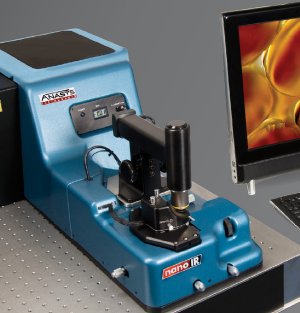 The Anasys nanoIR™ system
The editors of R&D Magazine have announced the winners of the 48th Annual R&D 100 Awards, which salute the 100 most technologically significant products introduced into the marketplace over the past year. “The launch of our nanoIR technology has generated lots of attention in spectroscopy and microscopy communities worldwide. The additional recognition by an external panel of experts through the R&D 100 award is very exciting,” explains Kevin Kjoller, Anasys Instruments’ co-Founder and VP of Product Development.
“With the nanoIR product we sought to overcome two major barriers--fundamental spatial resolution limits in convention infrared microspectroscopy and the lack of chemical characterization in atomic force microscopy (AFM). With this breakthrough we've exceeded spatial resolution in IR spectroscopy by more than an order of magnitude and can now do local chemical characterization and identification with the probe tip of an AFM,” says Craig Prater, Chief Technology Officer of Anasys. In addition to revealing chemical composition, the nanoIR system provides high-resolution characterization of local topographic, mechanical, and thermal properties. nanoIR is providing a new tool to help facilitate materials and life science research at the nanoscale.
“Infrared microspectroscopy has already proven itself extremely valuable for addressing a wide range of problems in science and industry,” says Dr. Curtis Marcott, senior partner at Light Light Solutions, a leading spectroscopy consultancy firm. “I’m excited about the new technology from Anasys, as it will let us break through the submicron spatial resolution barrier and apply IR spectroscopy to new classes of problems beyond our current capabilities.” Dr. Marcott is the president-elect of the Society of Applied Spectroscopy and a retired research fellow from Procter & Gamble.
The nanoIR system is the result of several million dollars of government and private investment. Anasys Instruments was awarded $2.6 million in research grants from the NIST Advanced Technology Program and the National Science Foundation. U.S. and foreign patents are pending.
Potential nanoIR application areas include polymer blends, multilayer films and laminates, organic defect analysis, tissue morphology and histology, subcellular spectroscopy, and organic photovoltaics. For further details, please visit the Anasys website.