Two materials scientists at the U.S. Department of Energy’s Argonne National Laboratory have received the 2009 Presidential Early Career Awards for Scientists and Engineers (PECASE), the nation’s highest honor for researchers in the beginning stages of their independent research careers.
Argonne materials scientist Dillon Fong and nanoscientist Elena Shevchenko were selected by the White House Office of Science and Technology Policy for their contributions to meeting America’s scientific and technological missions and the country’s economic, energy, health and security needs. “Science and technology have long been at the core of America’s economic strength and global leadership,” said President Obama. “I am confident that these individuals, who have shown such tremendous promise so early in their careers, will go on to make breakthroughs and discoveries that will continue to move our nation forward in the years ahead.”
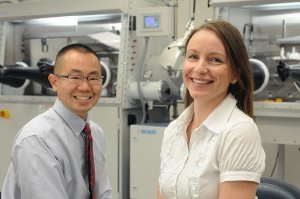 Argonne materials scientist Dillon Fong (left) and nanoscientist Elena Shevchenko received 2009 Presidential Career Awards for Scientists and Engineers
“I am so honored to be both nominated and selected for this award,” Shevchenko said. “Nanoscience is a burgeoning field of science with so many discoveries to be made. There are so many possibilities for the future and I am excited to be a part of it.”
Shevchenko, who heads the NanoBio Interfaces Group in Argonne’s Center for Nanoscale Materials, achieved wide recognition for her work in the design and synthesis of nanoparticles, which are small assemblies of particular materials that have special properties.
Shevchenko’s work specifically examined how nanoparticles self-organize to form more complicated materials. “Self-assembly is a natural pathway to create matter at atomic and macromolecular levels,” she said. “By mixing and matching different types of nanocrystals and controlling the interaction of neighboring constituents, we can design a wide range of transformative and inexpensive new materials.”
Fong works in Argonne’s Materials Science Division, where he investigates the formation and structure of complex oxide thin films. "In my research, we ask questions like how these thin film crystals grow, and how much of this growth can we control?" Fong said. "Furthermore, how do these materials behave when they are only a few nanometers thick?"
Both Fong and Shevchenko use the high-energy X-rays produced by Argonne’s Advanced Photon Source (APS). Some of Fong’s research at the APS examines the ferroelectric properties of certain films, which could eventually have applications in a range of energy technologies. “I am honored to receive this award, and the recognition should be shared by all the people at Argonne who further the quest to discover new materials and their properties,” Fong said.
Last year, Shevchenko was also recognized as one of the country’s top young innovators by Technology Review magazine, which is published by the Massachusetts Institute of Technology.
Shevchenko, Fong and the other PECASE winners will receive their awards at a ceremony at the White House later this year.