Online tool estimates displacement, force, capacitance, and resonance behavior from component geometry and material inputs.
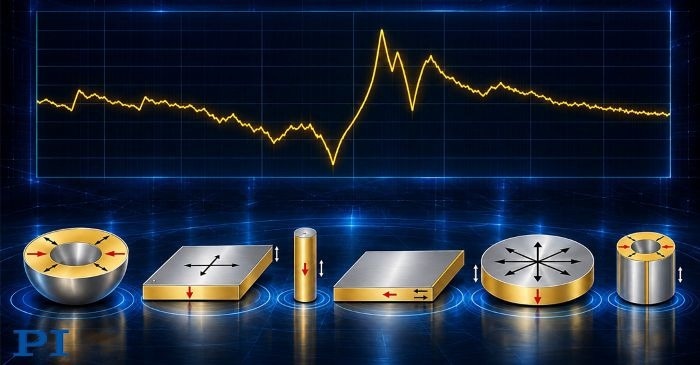 Piezo component calculator helps engineers evaluate piezoceramic designs. Image Credit: PI (Physik Instrumente) LP
PI (Physik Instrumente) offers an online Piezo Component Calculator for engineers evaluating piezoceramic components early in the design process. Users can select a component geometry and PI ceramic material, enter dimensions and operating conditions, and compare estimated mechanical and electrical behavior before committing to a design.
The calculator supports common forms such as discs, rings, tubes, plates, cylinders, and shear plates. Depending on the selected geometry, engineers can estimate displacement at a given voltage or the voltage needed for a target displacement. They can also examine blocking force, force–displacement behavior, capacitance, mass, and thickness or transverse resonance and antiresonance frequencies.
These estimates help answer practical application questions: Will a transducer deliver enough motion under load? What capacitance must the drive electronics handle? How will a change in diameter, thickness, or ceramic material affect the operating frequency? For an ultrasonic device, resonance is often a primary design constraint. For a positioning actuator, available displacement and force may matter more.
Engineers developing ultrasound imaging and therapeutic devices, flow meters, inspection transducers, hydrophones, nebulizers, and precision actuators can use the calculator to compare candidate designs quickly. It is suited to feasibility studies and component selection; detailed mechanical design and validation still require application-specific analysis and testing.
Try the PI Piezo Component Calculator.
Applications and Industries Served
Medical & life sciences, ultrasound imaging, therapeutic ultrasound, surgical tools, drug delivery and nebulizers, microfluidics, industrial & manufacturing, flow metering, flaw detection, material characterization, digital printing, aerospace & defense, structural health monitoring, sonar and hydrophones, active vibration damping, precision guidance systems.