In principle, any 'small' particle, even under 1 nm, can be measured using the DLS method. All that is required is that the particles scatter sufficient light, the particles diffuse freely and that the number f particles in the measurement volume are sufficient to suppress number fluctuations.
Factors Affecting Light Scattering
The amount of light scattered is a function of the relative refractive indices of the particle or molecule and the dispersant. The number of particles in the detection volume is unlikely to be a problem with sub 10 nm particles.
However, for such small particles, the level of the scattered light usually is very small, even at higher concentrations, and only the most sensitive instruments are capable of performing DLS measurements in this range. The Malvern Panalytical HPPS has a claim to be the most sensitive DLS system available and sizing of even sub-nanometer particles is within reach.
Case Study - Cholesterol
The sample chosen to test the sensitivity was Cholesterol at approximately 20 mg/ml in Butanone.
Equipment Used
Malvern Panalytical HPPS, Cholesterol, 1,2-Butanone, syringe / 0.2ìm syringe filter, square glass cuvette, 375ìl sample volume.
Sample Preparation and Measurement
100 mg Cholesterol was dissolved in 5ml degassed 1,2-Butanone and the resultant solution filtered through a 0.2ìm syringe filter, into a clean and dust free glass cuvette.
The cuvette was inserted into the Malvern Panalytical HPPS and 30 minutes was allowed to elapse to ensure thermal equilibration of the sample at 50°C. After this period, a measurement of 120 s duration was performed.
Example and Results
The correlation function in (Fig. 1) clearly shows at least two slopes indicating a short time fluctuation due to a small component (A), and a slower component (B) indicating the presence of larger material. These slower fluctuations could be seen in the butanone solvent when measured on its own, while the faster component was absent.
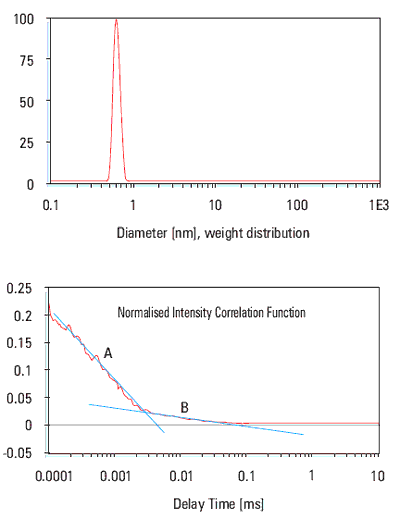
Figure 1. Particle size distribution of cholesterol as measured by a Malvern Panalytical HPPS using dynamic light scattering.
This demonstrated that the fast component is due to the cholesterol, with the hydrodynamic diameter calculated as 0.64 nm.
As expected, when the weight distribution is calculated, the cholesterol is the dominating component. While literature values for the hydrodynamic diameter of cholesterol in 1,2- Butanone are not easily found, the particle size measured here comes close to the value expected when calculated using a simple relationship between molecular weight and hydrodynamic diameter.
Conclusion
The extremely high sensitivity of the Malvern Panalytical HPPS allows size measurement of sub-nanometer particles and molecules in solution, as demonstrated by the analysis of Cholesterol. The count rate obtained from this experiment indicates measurement at a concentration as low as 10 mg/ml is feasible.

This information has been sourced, reviewed and adapted from materials provided by Malvern Panalytical.
For more information please visit Malvern Panalytical.