Size largely determines the sites of action of liposomes Zeta potential measurement enables the factors affecting size to be investigated.
Liposomes
What are Liposomes? They are simply vesicles or ‘bags’ in which an aqueous volume is entirely enclosed by a membrane composed of lipid (fat) molecules, usually phospholipids.
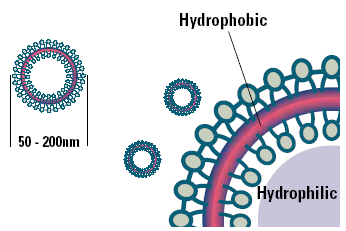
These spontaneously form when lipids are dispersed in water.
Why are Liposomes Used?
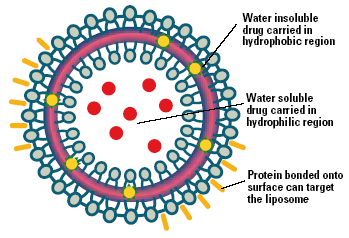
They can be used to entrap materials such as drugs both within the central aqueous compartment if they are water soluble, or within the membrane if they are oil soluble.
In addition the surface can be modified to ‘target the liposome’.
What Are Current Applications of Liposomes?
Current applications of liposomes include:
- As vehicles to deliver drugs to specific parts of the body e.g. Ambiosome®, an antifungal drug (liposomal amphotericin B)
- To allow much smaller doses of drug to be used to reduce side effects
- In cosmetics as "antiwrinkle" agents
- Currently being studied for use in gene therapy
- To effectively target to various bacteria and enhance the inhibition of bacterial growth compared to equal concentrations of the free drug e.g. in toothpaste
Why are The Size of Liposomes Important?
The sites of action of liposome-cell interactions in the body are determined to a large extent by size:
- Small liposomes can pass through the fenestrae of the liver sinusoids
- Intermediate sized liposomes are retained within the blood compartment and can circulate for long periods.
- Larger liposomes rapidly taken up by Kupffer cells
What Determines the Behaviour of Liposomes in the Human Body?
The behaviour of liposomes in vivo is determined by:
- Physical size
- Chemical composition
- Membrane permeability
- Quantity of entrapped solutes
How are the Sizes of Liposomes Measured?
Two main methods are used for size measurement in liposome research, electron microscopy and Photon Correlation Spectroscopy
Advantages of Photon Correlation Spectroscopy (PCS)
- PCS is a very rapid technique, typical measurements taking between 2 and 5 minutes. With sample preparation, electron microscopy will take much longer.
- Liposomes are measured in their natural state, there are no problems of dehydration or staining required. Electron microscopy requires the specialised freeze fracture technique.
- PCS measures the distribution of tens of thousands of particles. EM would require hundreds of photographs to give comparable statistics.
Applications of Size and Zeta Potential
Zeta potential is a fundamental tool used to investigate how size changes, as a function of any parameter of the preparation.
- Monitor the effect of changing the environment, e.g. pH, temperature, surfactant, blood serum, presence of counterions, adsorption of proteins.
- Develop formulations that resist aggregation/flocculation
- Measure the thickness of coatings on the surface of the liposomes.
- Predict the effectiveness of the coating of liposomes against opsonisation in vivo.
- Obtain information about whether the active agent used is encapsulated or adsorbed on the surface.
Liposomes in Gene Therapy
- Obtain information about DNA-liposome interactions, DNA-peptide interactions and condensing of DNA for liposomal encapsulation
- Follow the changes in size of liposome-drug complexes as their ratio is altered

This information has been sourced, reviewed and adapted from materials provided by Malvern Panalytical.
For more information please visit Malvern Panalytical.