Gene therapy is the process by which genetic material is delivered, by means of a vector, to patients for a therapeutic purpose. Vectors are delivery vehicles - usually a virus or a liposome - used to transport the genetic material to target cells in the body.
Liposomes in Gene Therapy
Both cationic and anionic liposomes are currently being investigated as vectors for gene therapy and their effectiveness in transfection is being studied by research groups and pharmaceutical companies.
Cationic Liposomes
Cationic liposomes (positively charged) are complexed with DNA (plasmids) Fig. 1.The liposome:DNA ratio is seen to be essential for optimal transfection.
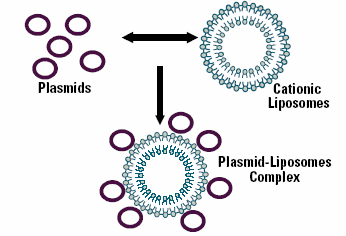
Figure 1. Cationic liposomes (positively charged) are complexed with DNA (plasmids)
Zeta Potential and Photon Correlation Spectroscopy (PCS) in Optimisation of Plasmid:Liposome Complexes
Zeta potential measurements can be used to optimise the ratio required for particular liposomes with various plasmids Fig 2.The plot also shows the z-average diameters of the complex formed at various plasmid:liposome ratios obtained from photon correlation spectroscopy (PCS) measurements.When the complex has either a high negative or positive zeta potential, the size is around 90nm. However, when the zeta potential approaches the iso-electric point, the z-average diameter increases indicating aggregation of the complex. Zeta potential measurements in conjunction with PCS sizing measurements allows for detailed characterisation of such plasmid: liposome complexes.
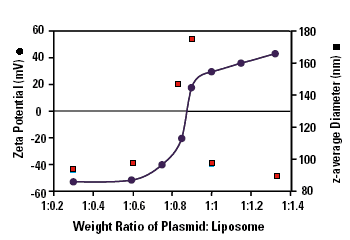
Figure 2. Zeta potential measurements can be used to optimise the ratio required for particular liposomes with various plasmids.
Applications
- Zeta potential is a powerful tool for all aspects of liposome research
- Development of targeted drug carriers
- Coating of liposomes for longer circulation times
- Development of systems for gene therapy
- Research into the physical properties of liposomes
Optimisation of the Compacting Agent
Anionic liposomes are used to encapsulate DNA. Negatively charged DNA needs to be condensed into small particles by adding some kind of compacting agent such as positively charged polylysine before encapsulation. (Fig. 3)
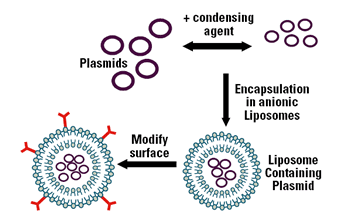
Figure 3. Condensing plasmids to enable optimum encapsulation in anionic liposomes.
Zeta potential measurements can be used to determine the amount of compacting agent required to reach neutrality for high encapsulation efficiency (Fig. 4). In addition, any subsequent modification to the surface of the liposome can be investigated by monitoring the change in the measured zeta potential.
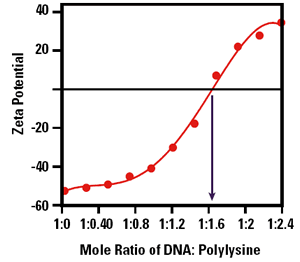
Figure 4. Measurement of the zeta potential as a function of the mole ratio of DNA:polylysine
Determination of the Charge of Liposome/DNA Complexes
Lipofectin (Liposomal transfection agent) is a commercially available liposome preparation for transfection. The liposomes are cationic consisting of DOPE and DOTMA DNA is complexed with the Lipofectin. Research is going on into the developing complexes of Lipofectin, DNA and receptorspecific peptides. Zeta potential measurements are used to determine the charge of the resulting complex.
Development of More Efficient Formulations
Much work is being done in the development of vectors containing specific molecules. Liposomal systems containing certain cell surface receptor-specific peptides are being developed. The use of antibodies, either covalently attached onto the surface of neutral and anionic liposomes or used in a complex, is also being investigated.
Zeta potential measurements are being used to develop the most efficient formulations of liposomes:peptides: DNA complexes for transfection studies in vivo and in vitro.
This information has been sourced, reviewed and adapted from materials provided by Malvern Panalytical.
For more information please visit Malvern Panalytical.