Lab-on-a-chip refers to technologies which allow operations which normally require a laboratory -synthesis and analysis of chemicals - on a very miniaturized scale, within a portable or handheld device.
Lab-on-chip devices offer many benefits to operating at this scale. Analysis of samples can take place in real-time, exactly where the samples are generated, rather than being transported around to a large laboratory facility.
Microfluidic devices can investigate the differences in fluid dynamics on a very small scale meaning that it is easier to control the movement and interaction of samples, making reactions much more efficient, and reducing chemical waste.
The main challenge to the development of lab-on-a-chip devices is the design and fabrication of devices on a very small scale that are functional and cost-effective. In recent years, advances in materials, and in micro- and nanofabrication techniques, have allowed a number of lab-on-a-chip type devices to be built and tested.
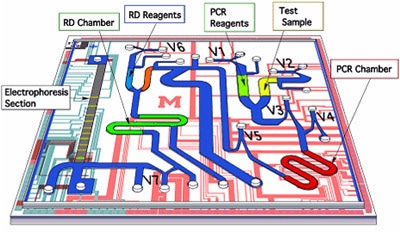
Figure 1. Schematic of the "Genotyper" device, developed by researchers at the University of Michigan, which could identify different strains of flu. Image Credits: Dr Ronald Larson, via NIAID.
Microfluidics and Nanofluidics
Lab-on-a-chip integrates many different areas of technology. The one which ties them all together and makes the whole concept possible, however, is microfluidics and nanofluidics.
Microfluidics is defined as the manipulation of the flow of very small quantities of fluid within channels in the micrometre range - nanofluidics takes this a stage further and often deals with the movements of individual macromolecules in solution. Understanding and commercializing this area of physics has been crucial to the development of viable lab-on-a-chip devices.
The discipline of microfluidics developed as a consequence of increasingly accurate analysis techniques such as high-performance liquid chromatography (HPLC) and capillary electrophoresis (CE), which are able to obtain extremely accurate results from a small sample size. As the capabilities of these techniques progressed, it was a natural step to try and perform them in as compact a form factor as possible.
Role of Nanotechnology in Lab-on-a-Chip
Developments in the field of nanotechnology and miniaturized devices have been crucial to enabling lab-on-a-chip devices. In particular, lithography, which has been used to create nanoscale features on metal and semiconductor surfaces, has been adapted to create tiny, micro-scale pumps, valves and other components for manipulating flow from polydimethylsiloxane (PDMS). PDMS is a transparent, flexible elastomer, which is better suited to rapid prototyping and allowing optical tests in microfluidic systems than traditional lithography materials.
 |
|
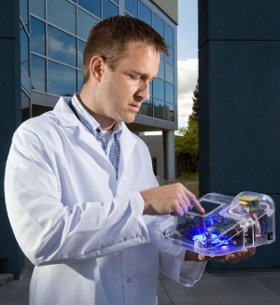
Figure 2. The RapiDx lab-on-a-chip system from Sandia National Laboratories can analyze microlitre samples of blood or saliva for protein signatures for biotoxins at the point-of-care. Image Credits: Sandia National Laboratories
|
Nanosensors are also a key element of many lab-on-a-chip systems. Sensors have been developed using nanomaterials like carbon nanotubes, capable of detecting very low concentrations, even down to single molecules in some cases. These are extremely useful in allowing a high degree of analytical flexibility in a lab-on-a-chip system without increasing the overall size of the device.
Applications of Lab-on-a-Chip in Life Sciences
While there are applications for lab-on-a-chip systems for small-scale, rapid synthesis and analysis in the chemical industry, the majority of research to date has focused on diagnostic devices for use in GP's offices or at sites without access to full laboratory facilities as well as point of care diagnostics.
Medical and life science applications which have been explored include DNA or RNA sequencing, and examination of protein crystallization to screen for conditions. Sample sizes can be just a single cell or even smaller. Rapid, bespoke synthesis of radioactively-labelled compounds for techniques like positron emission tomography (PET) has also been investigated.
Conclusions
Future advancements in lab-on-a-chip technology will always depend on at least two major scientific disciplines - microfluidics, and molecular biology. Nanotechnology will play a key role in tying these two fields together as the technology progresses.
Despite the hurdles always associated with the commercialization of new technology, viable examples of these devices are beginning to appear on the market. It seems that lab-on-a-chip technology will become increasingly important for analysis systems in the coming years, both in the medical world and in the chemical industry.
References and Further Reading