Jun 24 2009
A group of University of Oklahoma researchers led by Dr. James P. Shaffer, Homer L. Dodge Department of Physics and Astronomy, have discovered giant Rydberg molecules with a bond as large as a red blood cell. Determining how Rydberg molecules interact is important because Rydberg atoms are a key ingredient in atom based quantum computation schemes.
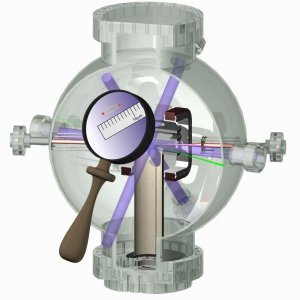 The main figure is a drawing of the laser cooling and trapping apparatus used to detect the Cs macrodimers. The magnifying glass is a cartoon that represents the idea that the apparatus is like a microscope for observing the molecules. The size is represented by the vernier in the magnifying glass. (Credit: Dr. James P. Shaffer)
Giant Rydberg molecules are formed when two Rydberg atoms interact. A Rydberg atom is an atom that has at least one electron orbiting the nucleus at a very large distance. A giant molecule can form from two Rydberg atoms when they are in close proximity to one another because fluctuations of the electron orbiting the nucleus can create an electric field at the position of the other Rydberg atom and vice versa to attract the atoms to each other.
An additional electric field can change the orbit of the electrons and lead to a change in the forces acting between the Rydberg atoms. The ability to change the orbit of the electron with an electric field is what makes it possible to control the properties of the molecule, such as binding energy and vibrational frequencies. Applying an electric field to tailor the properties of these types of molecules is a unique property.
The characteristics of the macroscopic molecules make them ideal candidates for probing quantum gases, properties of the electromagnetic field, and determining how Rydberg molecules interact. Shaffer says an understanding of these problems will bring us closer to a new generation of quantum mechanical devices that meld the best properties of isolated atomic systems with advances in microelectronic fabrication and materials science.
The research performed by Shaffer, K.R. Overstreet, A. Schwettmann, J. Tallant, and D. Booth is reported in the advanced online version (June) of Nature Physics and in the July issue of the scientific journal.