Jul 1 2009
For a long time, batteries were bulky and heavy. Now, a new cutting-edge battery is revolutionizing the field. It is thinner than a millimeter, lighter than a gram, and can be produced cost-effectively through a printing process.
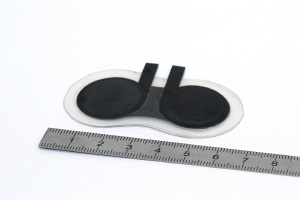
In the past, it was necessary to race to the bank for every money transfer and every bank statement. Today, bank transactions can be easily carried out at home. Now where is that piece of paper again with the TAN numbers? In the future you can spare yourself the search for the number. Simply touch your EC card and a small integrated display shows the TAN number to be used. Just type in the number and off you go. This is made possible by a printable battery that can be produced cost-effectively on a large scale. It was developed by a research team led by Prof. Dr. Reinhard Baumann of the Fraunhofer Research Institution for Electronic Nano Systems ENAS in Chemnitz together with colleagues from TU Chemnitz and Menippos GmbH. “Our goal is to be able to mass produce the batteries at a price of single digit cent range each,” states Dr. Andreas Willert, group manager at ENAS.
The characteristics of the battery differ significantly from those of conventional batteries. The printable version weighs less than one gram on the scales, is not even one millimeter thick and can therefore be integrated into bank cards, for example. The battery contains no mercury and is in this respect environmentally friendly. Its voltage is 1.5 V, which lies within the normal range. By placing several batteries in a row, voltages of 3 V, 4.5 V and 6 V can also be achieved. The new type of battery is composed of different layers: a zinc anode and a manganese cathode, among others. Zinc and manganese react with one another and produce electricity. However, the anode and the cathode layer dissipate gradually during this chemical process. Therefore, the battery is suitable for applications which have a limited life span or a limited power requirement, for instance greeting cards.
The batteries are printed using a silk-screen printing method similar to that used for t-shirts and signs. A kind of rubber lip presses the printing paste through a screen onto the substrate. A template covers the areas that are not to be printed on. Through this process it is possible to apply comparatively large quantities of printing paste, and the individual layers are slightly thicker than a hair. The researchers have already produced the batteries on a laboratory scale. At the end of this year, the first products could possibly be finished.