Sep 8 2009
Mention of nanotubes usually means carbon nanotubes. But not all tiny tubes are made of carbon. For example, layers made of nanoscopic titanium dioxide have proven to be useful materials for biotechnology, catalytic converters, and solar cell technology. Although the semiconducting properties of these nanotubes are critical for many of these applications, their limited conductivity represents a hindrance for other areas of application. A team at the University of Erlangen-Nürnberg and the University of Turku in Finland has now found an easy way to breathe some metal-like conductivity into the nanotubes without changing their structure. Through carbonization, the titanium dioxide can be converted into a carbon-containing titanium oxycarbide compound. As the researchers led by Patrik Schmuki report in the journal Angewandte Chemie, this novel material could drastically increase the efficiency of methanol fuel cells.
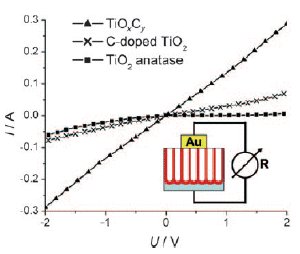
In order to carbonize titanium dioxide nanotubes, the researchers treated them with acetylene at 850 °C. This forms a carbon-rich compound with semimetallic properties, which is also significantly harder than before carbonization. “This is not about simply doping titanium dioxide with carbon atoms,” clarifies Schmuki. “Although the ordered tube structures remain almost completely unchanged, a new chemical compound is formed. This titanium oxycarbide can be interpreted as a solid mixture of titanium carbide and various titanium oxides.” Its high electrical conductivity and favorable electrochemical characteristics make this new material an interesting new electrode material.
Its use in methanol fuel cells seems particularly attractive. These days, methanol oxidation is usually carried out at catalytic electrodes with a carbon support and a platinum or ruthenium catalyst. “Titanium dioxide nanotubes have been under consideration as an alternative to the carbon support for a number of years,” says Schmuki. “But our new conducting oxycarbide beats these by a mile: Supports made of the oxycarbide increase the activity of the catalyst for the methanol oxidation by 700 %.”