Sep 10 2009
Our society is insatiable as far as the transfer of data is concerned. Consequently, increasingly faster and cheaper transistors are being developed. In row in recent months, researchers from ETH Zurich have now broken the world record for the switching speed of nitride-based transistors that use silicon as a substrate several times.
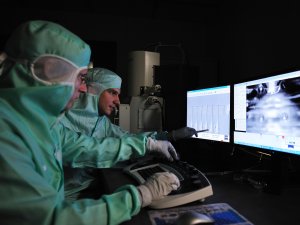 The transistors are produced under clean-room conditions in the Firstlab. (Photo: O. Ostinelli/ETH Zurich)
The transistors are produced under clean-room conditions in the Firstlab. (Photo: O. Ostinelli/ETH Zurich) (more pictures) Although Youtube was for example only founded in 2005, 100 million videos are watched daily on its platform, and the amount of digital information in our society is constantly rising. In 2006, for example, 161 billion gigabytes of digital information were produced – three million times as much information ever stored in books. What’s more, by 2010 this figure will already have increased to about 1000 billion gigabytes per year.
Few people are aware that not only does one always need better software to process such enormous amounts of data, but that the demands on hardware also continually increase. Transistors are pivotal elements in this struggle: small semiconductor components that can be controlled through the flow of electrons to work like microscopic switches or amplifiers in the nanometer scale.
Faster and faster the goal
Colombo Bolognesi, Professor of TeraHertz Electronics at the Laboratory of Electromagnetic Fields and Microwave Electronics, and his group are experts when it comes to fast transistors. Their goal is to improve their speed of operation. After all, the faster a transistor operates, the more information it can process in a given time. The researchers therefore combine semiconductor materials in different layers to enable the electrons to flow as quickly as possible. They also try to make the transistors as small as possible so that the electrons travel shorter distances, thereby enhancing the operation speed of the devices. These semiconductor layers have to be prepared under the cleanest conditions as they are often only as thick as a few atomic layers. Bolognesi’s research group is thus one of the principal users of the FIRST Lab (http://www.first.ethz.ch/) on the Hönggerberg. One of the special transistor technologies that Bolognesi’s group is working on is based on aluminium gallium nitride (AlGaN/GaN) and has high electron mobility, thus belonging to the “High Electron Mobility Transistors (HEMTs)” class of transistors.
AlGaN/GaN HEMTs are of technological importance because they can support large current flows and high voltages while remaining functional at elevated temperatures. Over the last few months, Bolognesi and his students have managed to beat the record for the switching speed of AlGaN/GaN HEMTs on silicon substrates several times in a row: the record is now 108 GHz. “Other groups had only managed 28 GHz up to now using similar technology, so we are almost four times as fast”, says Bolognesi, putting his team’s achievement into perspective.
Price is the deciding factor
Usually, sapphire or silicon carbide is used as the substrate material for AlGaN/GaN HEMTs. However, in consumer electronics the part price plays a big role, as does device performance. For large scale production, every cent you save on a transistor means a better profit. This is why intensive research is being conducted worldwide on realizing efficient AlGaN/GaN transistors on low-cost silicon substrates.
Silicon is cheaper than the customary substrates currently available as it is extremely abundant in nature, constituting about 26 percent by weight of the earth’s crust. For Bolognesi, likely high-volume applications for AlGaN/GaN HEMTs on silicon will be in automotive anti-collision radars which operate at 77 GHz, or in mobile telephone base station transmitter systems. In particular, such transmitters could save energy through components that also work with a much better efficiency than currently available alternatives. This would not only be good for the mobile phone operators’ wallets, but also for the environment. However, Bolognesi states that the direct commercial application is not the primary aim of his team’s research: “We are looking to demonstrate what is possible in practically manufacturable devices while trying to push their physical limits of operation.”