Sep 16 2009
PTB has for the first time made graphene visible on gallium arsenide - A successful combination of two unique electronic materials.
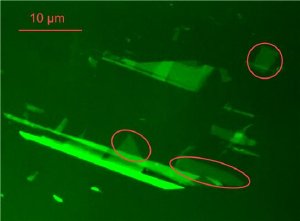 The normally practically invisible single-carbon-atom layers can be made visible under a normal light (optical) microscope, if the support (layer) is designed as an anti-reflection filter. Single-layer graphene was identified inside the markings. (Image: PTB)
It is the marriage of two top candidates for the electronics of the future, both excentric and extremely interesting: Graphene, one of the partners, is an extremely thin fellow and besides, very young. Not until 2004 was it possible to specifically produce and investigate the single layer of carbon atoms. Its electronic properties are remarkable, because, among other things, its electrons can move so tremendously fast. It is a perfect partner for gallium arsenide, the semiconductor that allows tailoring of its electrical properties and which is the starting material of the fastest electrical and opto-electronic components. Besides, it is possible to produce gallium arsenide with an atomic-layer-smooth surface; this should suit well as a support for graphene. Scientists of the Physikalisch-Technische Bundesanstalt (PTB) have now, with the aid of a special design, succeeded in making graphene visible on gallium arsenide. Previously it has only been possible on silicon oxide. Now that they are able to view with a light optical microscope the graphene layer, which is thinner than one thousandth of a light wavelength, the researchers want to measure the electrical properties of their new material combination. As experts for precision measurements, the PTB physicists are thus especially well equipped to do this.
They use the principle of the anti-reflective layer: If on a material one superimposes a very thin, nearly transparent layer of another material, then the reflectivity of the lower layer changes clearly visibly. In order to make their lower layer of gallium arsenide (plus graphene atomic layer) visible, the PTB physicists chose aluminium arsenide (AlAs). However, it is so similar to gallium arsenide (GaAs) in its optical properties that they had to employ a few tricks: They vapour-coated not only one, but rather several wafer-thin layers. "Thus, even with optically similar materials it is possible, in a manner of speaking, to 'grow' interference effects", Dr. Franz-Josef Ahlers, the responsible department head at PTB, explained. "This principle is known from optical interference filters. We have adapted it for our purposes".
First of all, he and his colleagues calculated the optical properties of different GaAs and AlAs layers and optimized the layer sequence such that they could expect a sufficiently good detectability of graphene. Following this recipe, they got down to action and with the molecular beam epitaxial facility of PTB accurately produced a corresponding GaAs/AlAs crystal atom layer. Then in the same procedure as with silicon oxide, it was overlaid with graphite fragments. "Different from silicon but as predicted by the calculation, although single carbon layers are no longer visible at all wavelengths of visible light, it is, however, possible, e.g. with a simple green filter, to limit the wavelength range such that the graphene is easily visible", explained Ahlers.
In the photo, all lighter areas of the dark GaAs are covered with graphene. From the degree of lightening it is possible to conclude the number of individual layers of atoms. The marked areas are 'real', that is, single-layer graphene. But next to them, there are also two, three and multiple layers of carbon atoms, which also have interesting properties. This arrangement was confirmed again with another method, Raman spectroscopy.
Following such a simple identification with a normal light optical microscope, the further steps in the manufacture of electrical components from graphene surfaces are now possible without any difficulty. Thus the PTB scientists can now begin to accurately measure the electrical properties of the new material combination.