Oct 13 2009
A new advanced method for nano-scale imaging of vesicle-fusion could add to our understanding of diseases of the nervous system and viral infections. In the long term, this could be useful in developing a cure for neurological diseases and mental disorders (e.g. schizophrenia, depression, Parkinson's disease, Alzheimer's disease).
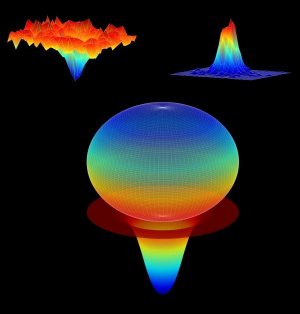 Researchers determine shape and size of the contact area between vesicle and membrane by measuring colour intensity from flourescent molecules. Right: Vesicle marked by acceptor flourescent molecules that light up when close to donor molecules (left). Middle: A plot of the same, calculated FRET. (Credit: Image courtesy of University of Copenhagen)
Neurons communicate with each other with the help of nano-sized vesicles. Disruption of this communication process is responsible for many diseases and mental disorders such as depression. Nerve signals travel from one neuron to another through vesicles -- a nano-sized container loaded with neurotransmitter molecules. A vesicle fuses with the membrane surrounding a neuron, releases neurotransmitters into the surroundings that are detected by the next neuron in line. However, we still lack a more detailed understanding of how the fusion of vesicles occurs on the nano-scale.
Associate Professor Dimitrios Stamou, Department of Neuroscience and Pharmacology and Nano-Science Center from University of Copenhagen explains: "Contact between vesicles and membranes are an essential step in many important biological processes. We can now quantify contact areas formed between vesicles and determine the vesicle size and shape with nano-scale resolution. This helps us characterise the properties of the molecules involved in vesicle-fusion. The new method opens great new prospects for the research of neurological and infectious diseases".
Images on the nano-scale
The researchers are using a method called FRET or Fluorescence Resonance Energy Transfer. The method is well known, but what is new is the way the researchers are using it. They produce vesicles in the laboratory, which contain fluorescent donor molecules, and membranes fixed to a surface. The fixed membranes contain acceptor fluorescent molecules. Only when the two different fluorescent molecules are near to each other will light be emitted, which researchers can measure as a sign of vesicle fusion. By measuring the emitted light the researchers found new ways to determine the vesicle shape with nano-scale resolution in real-time.
"We have lacked a method for measuring the fusion of vesicle and membrane on a nano-scale at the moment the process occurs. Until now it has only been possible to get a still image of the process with high resolution, or live images with low resolution. With the new method we can quantify the changes in vesicle shape live i.e. during fusion, and with nanoscale resolution," explains Dimitrios Stamou.
This research was recently published in PNAS (July 28, 2009 vol. 106 no. 30 12341-1234.)