Oct 15 2009
MIT physicist Pablo Jarillo-Herrero has won a 2009 David and Lucile Packard Fellowship, an award he will use to study a new class of materials that could have applications in the semiconductor industry and quantum computing.
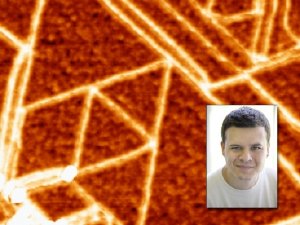 Pablo Jarillo-Herrero (inset) has won a 2009 David and Lucile Packard Fellowship. The image here shows the crystallographic structure of graphene, a novel material that Jarillo-Herrero plans to study with his Packard grant. Images courtesy of Pablo Jarillo-Herrero
The five-year, $875,000 grant will allow Jarillo-Herrero to explore the unique features of graphene and a type of materials known as topological insulators, whose electrons display unique behavior.
In most everyday materials, including metals and silicon, electrons behave just like other particles with mass — for example, their velocity depends on their energy.
Recently, scientists have discovered a new class of materials — including graphene and topological insulators — whose electrons behave more like massless particles such as neutrinos or photons rather than electrons. Electrons in these materials are described by putting Albert Einstein's special relativity and quantum mechanics together. "This grant is going to allow me to perform experiments to characterize and explore the fascinating behavior of electrons in these materials," says Jarillo-Herrero.
Graphene, a single layer sheet of carbon atoms arranged in a lattice, was discovered in 2004, and the first known topological insulator, an alloy of bismuth and antimony, was reported in 2007.
These new materials also exhibit high electron mobility, raising hopes that they could lead to smaller, faster computer chips, potentially replacing silicon.
While graphene is a two-dimensional example of this kind of material, topological insulators have three dimensions. A thin surface layer that exhibits the same relativistic quantum behavior seen in graphene coats an insulating interior. The electrons in the surface are insensitive to any impurities added to the surface, making topological insulators potential candidates for quantum bits, which could be used to build a robust quantum computer.
"You could, theoretically and hopefully experimentally, do quantum operations not affected by the environment," says Jarillo-Herrero, who is one of 16 recipients of this year's Packard Fellowships.
The Packard grants are similar to the MacArthur Fellowships — also known as "genius" grants — in that the funding is unrestricted: the recipients may use it as they choose. But while the MacArthur grants are shrouded in secrecy, the Packard fellows are nominated by the presidents of 50 universities that participate in the Packard Fellowship program.
MIT alumni Kevin Janes PhD '05 and Peter Huybers SM '02, PhD '04 also won Packard Fellowships this year.