Oct 19 2009
A University of Michigan professor is developing an electric rocket thruster, NanoFET, that uses nanoparticle electric propulsion and enables spacecraft to travel faster and with less propellant than previous technology allowed.
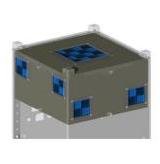 A University of Michigan professor is developing an electric rocket thruster (NanoFET) that uses nanoparticle electric propulsion and enables spacecraft to travel faster and with less propellant than previous technology allowed. Credit: Michael Rayle, Electrodynamic Applications, Inc.
The Air Force Office of Scientific Research is funding Professor Alec D. Gallimore's research because particle electric propulsion, with its half-inch thruster, increases velocity by several hundred or thousand miles an hour and is expected to have a dramatic impact on nanosatellites and larger spacecraft. These electric fields help to create thrust when the particles are charged, accelerated and propelled into space.
"Particles used in this technology are initially 10 to 50 nanometers in size (approximately a thousand times smaller than a human hair in diameter), and we scale them up to between one and ten microns (1/20th to about half the size of a human hair) because at that size, we can see and use them for advanced propulsion research," said Gallimore.
Even with the modifications there are still challenges in doing NanoFET research.
"There are material science aspects of designing the right materials that can withstand high voltages and close proximity to each other," Gallimore said. "There's also a challenge of making certain that all materials are in a form that fits on a satellite that's not much larger than a baseball." Currently the materials are more functional than form-fitting.
"We're hoping that we can actually resolve a lot of these issues in the next three to four years," said Gallimore.
In the meantime, the researchers have tested the nanoparticle, electric-based propulsion in air and in a vacuum chamber on an aircraft that replicates conditions of limited gravity.
"It has the potential to be a revolutionary propulsion concept, especially regarding nanosatellites and larger satellites, but there's also a possibility of applying the technology to non-space vehicle applications as well," he said.
AFOSR Program Manager, Dr. Mitat Birkan who oversees the research, agrees. "Electrostatic acceleration of charged nanoparticles has many potential applications besides space propulsion, including manufacturing and biomedical technologies."