JPK Instruments, a world-leading manufacturer of nanoanalytic instrumentation for research in life sciences and soft matter, is pleased to announce new electrochemical capabilities for their NanoWizard AFM systems.
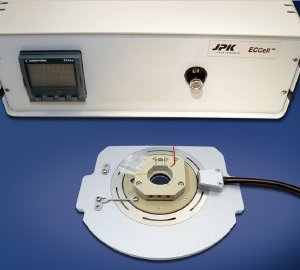 The JPK ECCell, suitable for NanoWizard and NanoWizard II AFM heads. The cell is shown together with the temperature controller unit.
Electrochemical experiments study redox reactions of substances at a solid-liquid interface. With atomic force microscopy, high-resolution images can be obtained in liquid as the electrochemical reaction progresses. Electrochemistry spans a wide range of fields, from the corrosion of metal surfaces through to the role of protein electron transfer processes in biosensors. The new JPK ECCell enables simultaneous AFM and electrochemistry with full environmental control. Uniquely, the cell enables simultaneous fluorescence experiments to be carried out when the JPK NanoWizard® AFM is operated on inverted optical microscopes.
The key challenge for the electrochemical cell design is to integrate the many components and control elements within a small volume around the AFM tip. This has been successfully achieved with the JPK ECCell, which offers the complete electrode set of working electrode, counter electrode and commercial reference electrode, together with an optional tip bias connection, for instance, for scanning electrochemical microscopy (SECM). The three fluid inlets allow liquid exchange during the measurements as well as gas exchange over the liquid in the chamber for inert gas experiments in an oxygen-free environment. The temperature control unit gives precise temperature stability from room temperature to 60°C in aqueous solutions.
The ECCell is compatible with a wide range of opaque or transparent samples, including standard coverslips, metal, or silicon chips. It can be used for simultaneous optical experiments if the sample is transparent. For example, ITO-coated coverslips allow conductive measurements simultaneously with high numerical aperture immersion objectives. The mechanical stability ensures that simultaneous high-resolution AFM imaging is possible. This allows exciting new experiments where the optical microscope is used to simultaneously observe the sample. For instance, living cells can be monitored on Multi-Electrode Arrays (MEAs), or fluorescence can be used to see electrochemical changes or switching of surface molecules.
Electrochemistry applications are extensive. Corrosion of metal surfaces is a well-established field with obvious economic as well as scientific interest. In many devices, electrically active or reactive polymer substances have an increasing role and significance as both, bulk materials and thin films.
In addition, electrochemistry is a powerful tool in biochemistry to study proteins undergoing or catalyzing redox reactions. Proteins in the lipid membrane enclosing living cells are sensitive to and control the potential difference across the membrane, for instance the ion channels in neuron cells.
To learn more about applications for the JPK ECCell capability, visit their web site at www.jpk.com.