Nov 2 2009
Solar wafers for use in the production of photovoltaic systems are extremely sensitive. In a test and demonstration center research is being conducted on grippers to determine the best way of handling delicate wafers in order to optimize the production process.
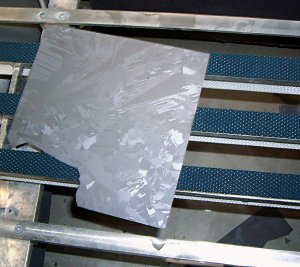
Accidents will happen: if you are washing a wine glass and apply just a little too much pressure it will break. A similar thing happens to technicians in the production of photovoltaic systems when they handle solar wafers. With a thickness of just 150 to 180 micrometers, the filigree substrates are extremely fragile. Various types of automatic gripper can be used to lift or transfer the wafers – mechanical grippers make direct contact with the object, while Bernoulli grippers create a vacuum to hold the wafer without actually touching it.
”The grippers must be able to work precisely and gently even at high speed, because they have to cause as little waste production as possible and yet handle a high throughput,” says Christian Fischmann, research scientist at the Fraunhofer Institute for Manufacturing Engineering and Automation IPA. He is currently evaluating different grippers and handling methods at the test and demonstration center being established by the Institute under an EU program. A key question is whether the robotic claw achieves the required level of precision. To the naked eye the movement looks ideal even when things are moving fast, but pictures taken with a high-speed camera show that there is actually a short time lag before the claw lets go of the object, which slows down the production cycle. Some steps in the production process require particularly gentle handling, for instance lifting a wafer from a stack. A method using jets of air separates the wafers gently: air is blown by nozzles into the stack, lifting the top wafer off the ones below so that it floats above the stack. Studies conducted by the Stuttgart group also show how production processes can be optimized using different gripper principles. Until now the general practice has been to employ only one type of claw along the entire production line, but the various handling methods are not equally well suited for every step in the process, Fischmann explains. “It all comes down to finding a balance between gentle handling, speed and operating cost.” Bernoulli grippers, for example, are relatively expensive to use because air has to be pumped through non-stop.
Even though the demonstration center is still in the development phase, several customers who want to have their gripper systems tested have already been acquired. The scientists now intend to expand their activities to include research on handling contaminated wafers and contamination caused by grippers.