Mar 9 2010
Materials such as paper, paint, and biological tissue are opaque because the light that passes through them is scattered in complicated and seemingly random ways.
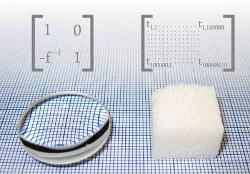 Knowing enough about the way light is scattered through materials would allow physicists to see through opaque substances, such as the sugar cube on the right.
A new experiment conducted by researchers at the City of Paris Industrial Physics and Chemistry Higher Educational Institution (ESPCI) has shown that it's possible to focus light through opaque materials and detect objects hidden behind them, provided you know enough about the material. The experiment is reported in the current issue of Physical Review Letters, and is the subject of Viewpoint in APS Physics (physics.aps.org) by Elbert van Putten and Allard Moskof the University of Twente.
In order to demonstrate their approach to characterize opaque substances, the researchers first passed light through a layer of zinc oxide, which is a common component of white paints. By studying the way the light beam changed as it encountered the material, they were able to produce a numerical model called a transmission matrix, which included over 65,000 numbers describing the way that the zinc oxide layer affected light. They could then use the matrix to tailor a beam of light specifically to pass through the layer and focus on the other side. Alternatively, they could measure light emerging from the opaque material, and use the matrix to assemble of an image of an object behind it.
In effect, the experiment shows that an opaque material could serve as a high quality optical element comparable to a conventional lens, once a sufficiently detailed transmission matrix is constructed. In addition to allowing us to peer through paper or paint, and into cells, the technique opens up the possibility that opaque materials might be good optical elements in nano-scale devices, at levels where the construction of transparent lenses and other components is particularly challenging.
Source: http://www.aps.org/