Distinguished Senior Scientist Nicholas Samios, former Laboratory Director and Director of the RIKEN BNL Research Center at the U.S. Department of Energy's (DOE) Brookhaven National Laboratory, has been chosen by the World Federation of Scientists (WFS) as the recipient of the 2009 Gian Carlo Wick Gold Medal Award, which is given annually to a theoretical physicist for outstanding contributions to particle physics. Samios was cited "for his visionary role in the successful construction of the Relativistic Heavy Ion Collider (RHIC), and for his intellectual leadership in a series of remarkable experimental discoveries which established the existence of Quark Gluon Plasma (QGP), a new phase of strongly interacting nuclear matter."
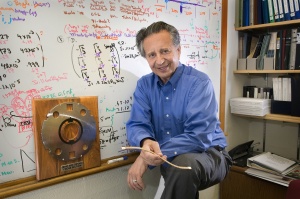 Nicholas Samios
"I am honored to be the recipient of this award and particularly pleased to be recognized for my efforts towards the successful construction, utilization, and physics productivity of RHIC," Samios said. "I must also acknowledge the major influence of the pioneering work of T.D. Lee and Gian Carlo Wick, who explored the structure of matter under extreme conditions of temperature and density, which greatly motivated the RHIC project," Samios said.
Said Brookhaven National Laboratory Director Samuel Aronson, "The stunning findings from RHIC have presented us with some challenges and surprises, the foremost being that the matter we've created appears to behave more like a liquid than the gas we had expected. Nick's vision in designing such a versatile machine has enabled a detailed exploration of the properties of this unique form of matter, and an equally compelling investigation of another scientific mystery — the origin of proton spin."
RHIC began operation in 2000, following ten years of development and construction. Hundreds of physicists from around the world use RHIC to study what the universe may have looked like in the first few moments after its creation. RHIC drives two intersecting beams of gold ions, gold atoms stripped of their electrons, into head-on subatomic collisions to learn about the forces that hold matter together — from the smallest subatomic particles to the largest stars. RHIC also collides beams of polarized protons to find out more about the property of spin, as intrinsic and important to a particle's identity as its mass and charge.
Samios first came to Brookhaven Lab as a summer student in 1952, and joined the Physics Department as an assistant physicist in 1959. Serving as Physics Chair, 1975-81, Deputy Director for High Energy & Nuclear Physics, 1981-82, and Laboratory Director, 1982-97, he was the person with ultimate responsibility for building RHIC.
"Nick understood the various theoretical conjectures motivating such a facility, and brought together various elements of the theoretical and experimental physics communities, as well as those involved in accelerator design, insisting on a flexible design for the machine so that it could produce ion-ion collisions at a range of energies, as well as proton-proton and proton-ion collisions," Aronson said. "Under his leadership, together with the then Associate Lab Director for High Energy & Nuclear Physics, Mel Schwartz, he also brought together the vision of a suite of overlapping yet complementary detectors at RHIC."
The versatility of the accelerator concept and the diversity of the experiments proved to be essential for the present success and future potential of the RHIC program.
Data collected and analyzed over nine years of operations from collisions of various species of ions over a broad range of energies clearly support the case that RHIC's gold-gold collisions are routinely producing a freely flowing liquid composed of quarks and gluons – the subatomic constituents of protons and neutrons. Such a substance, often referred to as quark-gluon plasma, last existed just after the dawn of the universe some 13 billion years ago. At early times in RHIC collisions of large nuclei, this matter has an energy density much greater than that inside a proton. The matter is so strongly interacting that it becomes nearly opaque to high-energy quarks passing through it. Its viscosity is so low it is believed to be near the predicted quantum limit, making the matter produced at RHIC the most nearly "perfect" liquid ever observed.
The accelerator and detector capabilities at RHIC are currently being upgraded to enhance the facility's potential for further discoveries. Among the promising scientific leads being pursued are: the possibility that cold nuclear matter attains an as yet undiscovered universal form under the conditions of very high gluon density that control the earliest stages of RHIC collisions; the possible existence within RHIC's region of accessibility of a unique nuclear matter "critical point" akin to the one where ice, water and steam can coexist; hints that certain fundamental symmetries of nature may be violated at the extreme temperatures reached in RHIC collisions and in the early universe; and possible solutions to the puzzle of how the proton spin arises from its quarks and gluons.
"The versatility and flexibility of the RHIC facility, conceived under the leadership of Nick Samios, position us well to continue our explorations into these exciting areas of physics," concluded Aronson. "It's especially satisfying to celebrate this recognition of Nick's accomplishments as we embark on this new frontier."
Nicholas Samios received his B.A. and Ph.D. degrees in physics from Columbia University in 1953 and 1957, respectively. As a Brookhaven researcher from 1959, Samios made many of the particle discoveries that have helped define and lead to the acceptance of the "Standard Model" of particle physics, the accepted theory that explains known particle interactions. In particular, he is noted for the discovery of the phi meson and the omega minus hyperon, crucial elements delineating the symmetry of hadrons, which ultimately led to the quark model of elementary particles, a pillar of the Standard Model.
Samios also made significant contributions through a decade-long study of neutrino interactions, both at BNL and at Fermi National Accelerator Laboratory. These studies included the discovery of the charmed lambda – the first charmed baryon observed — and early measurements of neutrino electron elastic scattering and limits on neutrino oscillations. A Distinguished Senior Scientist since 1997, he became Deputy Director of the RIKEN/BNL Research Center (RBRC) in 1998, and RBRC Director in 2003. RBRC is a research center at BNL funded primarily by the Japanese RIKEN Laboratory to explore both the theoretical and experimental physics potential of RHIC. Samios also held the position of adjunct professor in Columbia's Physics Department, 1970-95.
Samios' many honors include the 1980 E.O. Lawrence Memorial Award, the 1980 New York Academy of Sciences Award in Physical & Mathematical Sciences, the 1993 W.K.H. Panofsky Prize, and the 2001 Bruno Pontecorvo Prize of the Joint Institute for Nuclear Research in Dubna, Russia. He was elected to the National Academy of Sciences in 1982 and is a Fellow of the American Physical Society, the American Academy of Arts and Sciences, the American Association for the Advancement of Science, and the Akademia Athenon.