Asylum Research, the technology leader in Scanning Probe and Atomic Force Microscopy (SPM/AFM), has announced a new grant program for early adopters to explore the capabilities and applications of the unique new Band Excitation technique. Existing or new Asylum AFM users are encouraged to apply for grants valued at up to $50,000 USD. Additional information on grant submission content and procedures is provided at www.asylumresearch.com/grants.
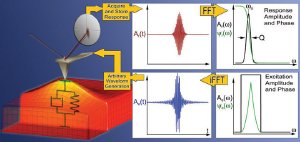 Operational principle of the BE method in SPM. The excitation signal is digitally synthesized to have a predefined amplitude and phase in the given frequency window. The cantilever response is detected and Fourier transformed (FFT) at each pixel in an image. The ratio of the fast FFT of response and excitation signals yields the cantilever response (transfer function). Fitting the response to the simple harmonic oscillator yields amplitude, resonance frequency, and Q-factor that are plotted to yield 2D images, or used as feedback signals. Reprinted with permission (Nanotechnology 18 (43) (2007)).
“The R&D 100 Award-winning Band Excitation (BE) technique has shown great promise in mapping the conservative interactions, nonlinearities, and energy dissipation of materials on the nanoscale,” said Roger Proksch, Asylum Research President and grants lead. “Stephen Jesse and Sergei Kalinin at Oak Ridge National Laboratory (ORNL), collaborating with Asylum Research, have developed the BE system where a synthesized excitation signal probes the response of a cantilever at multiple frequencies simultaneously. This method is a fast and sensitive technique which may be useful for understanding and mitigating energy losses in magnetic, electrical, and electromechanical processes and technologies. We encourage new and existing AFM users to apply for the BE grants and to work closely with the Asylum team to blaze new trails with this exciting new technique.”
Suggested grant topics include:
- Energy dissipation in materials.
- Contact resonance measurements for materials properties contrast and quantification.
- Electromechanical properties of materials, including piezo- and ferroelectrics.
- Applications of BE to solar materials – photovoltaics and energetic materials.
- BE methodologies applied to other active probes, such as localized thermal analysis.
- Biological materials including mechanical properties and recognition mechanisms.
- Advanced methodologies for data reduction and analysis.
- Probing nonlinear tip-sample interactions.
- Other nanoscale measurements that can benefit from rapid multiple frequency measurements.
“Classical scanning probe microscopies are based on the excitation and detection of single or, recently, dual frequencies. In doing so, the information on real tip-surface interactions manifested in the fine details of the resonance curve shape is not measured. Implementation of BE on multiple ambient and UHV systems at ORNL has allowed us to achieve several technical breakthroughs in mapping structure, magnetic and electrical dissipation, and electromechanical activity in ferroelectric, multiferroic, and biological systems in ambient, liquid, and vacuum environments,” commented Sergei Kalinin.
Added Stephen Jesse, “Classical SPM offers basically a gray-scale image of cantilever dynamics at a single frequency. Band excitation opens a new and colorful multi-frequency view of the nanoworld that we can already explore, but are just starting to appreciate”.