Stanislaus S. Wong, a scientist with a joint appointment at the U.S. Department of Energy's Brookhaven National Laboratory and Stony Brook University, has won the Buck-Whitney Award from the American Chemical Society (ACS) Eastern New York Section. The award recognizes excellent original contributions to pure and applied chemistry. Wong will receive the award at the ACS Eastern New York Section meeting in Albany on November 19.
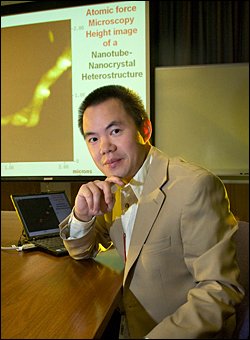 Stanislaus S. Wong
“I enjoy exploring the chemistry of nanostructures – structures with dimensions measuring mere billionths of a meter – as these hold promise for numerous future applications, and I am gratified that my research has been recognized by my peers,” Wong said.
Wong studies carbon nanotubes as well as metal oxide nanostructures in order to gain a basic understanding of their synthesis and properties. In addition, he modifies the nanotubes using chemical strategies to make them suitable for various applications. Carbon nanotubes have a hollow cylindrical structure that is just a few nanometers thick, or about 1/50,000 the thickness of a human hair, and have potential applications in electronics, optics, and materials science. Nanotubes possess intrinsic advantages including high surface areas, structural flexibility, and high mechanical strength. In fact, they might be stiffer and stronger than potentially any other known material, which is key for the design of high-performance composite materials. Moreover, their structure – for example, the way in which these tubes are rolled up – determines whether they are semiconducting or metallic. It is not surprising, therefore, that nanotubes are thought to have a host of wide-ranging, potential applications, including their use as catalyst supports, field emitters for flat panel displays, high strength engineering fibers in bulletproof clothing, sensors, gas storage media, and as molecular wires for the next generation of electronics devices such as transistors.
Wong also creates metal oxide and fluoride nanostructures of predictable size, chemical composition, and shape using benign, green techniques. Specifically, he has generated pure spherical particles, cubes, arrays, aggregates, and three-dimensional assemblies, as well as one-dimensional tubes and wires in order to understand how their characteristics change with these controlled modifications in structure.
Metal oxides, in particular, represent one of the most diverse classes of materials, with important structure-related properties, including superconductivity, ferroelectricity, magnetism, conductivity, and gas-sensing capabilities. Applications include catalysts, chemical and optical sensors, fillers, coatings, energy storage media, fuel cells, power generation, and solar cells as well as environmental remediation and sensing. In his research over the years, Wong has worked closely with innumerable colleagues at Brookhaven Lab and has used two of the Laboratory’s world-class facilities: the Center for Functional Nanomaterials and the National Synchrotron Light Source.
Stanislaus S. Wong earned a B.Sc. in chemistry from McGill University in 1994 and a Ph.D. in chemistry from Harvard University in 1999. He was a postdoctoral fellow at Columbia University before simultaneously joining Stony Brook University in 2000 as an Assistant Professor in the Chemistry Department and Brookhaven Lab as a scientific staff member in the Materials Sciences Division. In 2006, he was promoted to Associate Professor, the position he still maintains. Currently, he works in Brookhaven’s Condensed Matter Physics and Materials Science Department.
Wong has been honored with numerous awards, including the 3M Nontenured Faculty Award, the National Science Foundation’s CAREER Award, and an Alfred P. Sloan Foundation Research Fellowship.