The University of California Board of Regents on Nov. 19 named Paul Alivisatos director of the Department of Energy's Lawrence Berkeley National Laboratory, which is managed by the university. "Paul Alivisatos' scientific expertise and management experience have earned the respect and confidence of the lab staff, the academic community, the DOE, and other federal and industrial sponsors," said UC President Mark Yudof. "I am confident that Paul is the right leader for the Berkeley Lab at this pivotal point in its history. Under his leadership, Berkeley Lab will continue to make great contributions in science and to the world around us."
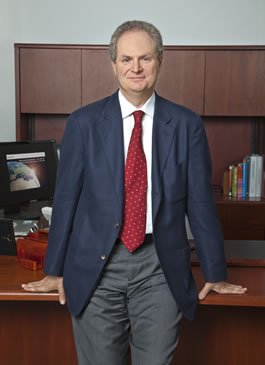 Paul Alivisatos Photo Credit: Lawrence Berkeley National Laboratory — Roy Kaltschmidt, Photographer
Acting on the recommendation of Yudof and with the concurrence of the U.S. Department of Energy, the Regents appointed Alivisatos the seventh director of Berkeley Lab. The appointment takes effect immediately. Alivisatos replaces Steven Chu, who was sworn in as U.S. Secretary of Energy in January 2009.
"I've known Paul for many years," said DOE Under Secretary for Science Steven E. Koonin. "He's a wonderful scientist and has done a fine job as interim director. All of us at DOE look forward to helping him take the lab to new heights."
The Board of Regents named Alivisatos interim director of Berkeley Lab in January 2009.
Since his appointment, Alivisatos has successfully led the laboratory in obtaining more than $220 million in funding from the American Recovery and Reinvestment Act. That funding will further the lab's work in many areas, including computing support to the nation's scientists, assistance to users of Berkeley Lab's flagship Advanced Light Source and development of a new laser accelerator.
In addition, Alivisatos and his management team are developing a number of new initiatives including a next-generation light source, integrating research on the carbon cycle across the lab, and reinvigorating the lab's safety culture and its community relations.
"Berkeley Lab is a state, national and global resource with a strong sense of responsibility to the country and a profound sense of urgency to help the Department of Energy fulfill its important missions," said Alivisatos. "I share these values and concerns and will work with my Berkeley Lab colleagues to ensure that we bring together the sharpest minds to find the best solutions to the energy problems that threaten our planet."
Prior to this appointment, Alivisatos was the deputy director of Berkeley Lab, serving as the lab's chief research officer and overseeing the discretionary research budget, key research initiatives and technology transfer functions. In addition, he assisted the director in developing the overall strategic direction and institutional planning for the laboratory.
Alivisatos is a leader of Berkeley Lab's Helios solar research initiative, where he is spearheading ground-breaking research on artificial photosynthesis and photovoltaic technology through the creation of nano-inspired devices.
From 2005 to 2007, prior to being named deputy director of the Berkeley Lab, Alivisatos was associate laboratory director for physical sciences. From 2002 to 2008 he was director of the materials sciences division and from 2001 to 2005 was director of the Molecular Foundry at the lab. Alivisatos has been a member of the faculty at UC Berkeley since 1988, following the completion of his postdoctoral work at AT&T Bell Laboratories. He is currently the Larry and Diane Bock Professor of Nanotechnology and a professor in the departments of materials science and chemistry.
Alivisatos is a scientific founder of Quantum Dot Corp. and Nanosys Inc., and a board member of Solexant Inc. Alivisatos is the founding editor of Nano Letters, a publication of the American Chemical Society.
Alivisatos has published widely and is the recipient of numerous awards and honors, including the Ernest Orlando Lawrence Award, the Eni Italgas Prize for Energy and Environment, the Rank Prize for Optoelectronics Award, the Wilson Prize, the Coblentz Award for Advances in Molecular Spectroscopy, and the Department of Energy's (DOE) Awards for Sustained Outstanding Research in Materials Chemistry and Outstanding Scientific Accomplishment in Materials Chemistry. He has held fellowships with the American Association for the Advancement of Science, the American Physical Society, the American Chemical Society and the Alfred P. Sloan Foundation. He is a member of the National Academy of Sciences and the American Academy of Arts and Sciences.
Alivisatos holds a Ph.D. in chemistry from UC Berkeley and a bachelor of arts in chemistry from the University of Chicago.
UC President Yudof initiated a national search for a permanent Berkeley Lab director in the summer of 2009. Yudof appointed a search committee of Regents and several prominent members of the university, laboratory and scientific community. The search committee was advised by a screening taskforce composed of eminent university and laboratory researchers and administrators. The search committee also received support from the executive search firm of Storbeck/ Pimentel and Associates.
As director of Lawrence Berkeley National Laboratory, Alivisatos will earn $417,155 annually, representing a 2.5 percent ($10,175) increase over the current annual salary and a 16.9 percent ($60,155 dollar) increase over his current base salary as laboratory deputy director. Per university policy, he will receive an annual automobile allowance of $8,916. Per policy, Alivisatos is eligible for participation in the UC Mortgage Origination Program. Alivisatos also will receive standard pension and health and welfare benefits and standard senior management benefits, including senior manager life insurance, executive business travel insurance, executive salary continuation for disability, and an administrative fund for official entertainment and other purposes that comply with university policy. As a member of the UC tenured faculty in a senior management position, Alivisatos is eligible to accrue sabbatical credits.
The director's salary, like that of all other UC employees at the laboratory, is paid from funds derived from the federal DOE contract. No general funds from the state are used to pay the director's salary.
The University of California has managed Berkeley Lab since its inception in 1931, when it was one of the first laboratories of its kind showing the extraordinary value of multidisciplinary research, which ultimately led to the creation of the national laboratory system. Founded by Ernest O. Lawrence, who won the Nobel Prize in physics in 1939 for his invention of the cyclotron, Berkeley Lab has evolved into a multidisciplinary research facility advancing the forefront of scientific knowledge and addressing problems of national and global concern.
The DOE's Office of Science is the steward of 10 laboratories in the national laboratory system, including Berkeley Lab.
Today, Berkeley Lab performs research in nanoscience and advanced materials, life sciences, computing, energy and Earth sciences, physics, and cosmology. It also operates a homeland security office dedicated to leveraging fundamental scientific research to develop methods for ensuring the safety of our country. Researchers at the laboratory have won nine Nobel Prizes and 12 National Medals of Science. More than 250 Berkeley Lab faculty and scientists hold